Showing posts with label Vibha Sharma. Show all posts

Saturday, April 23, 2022

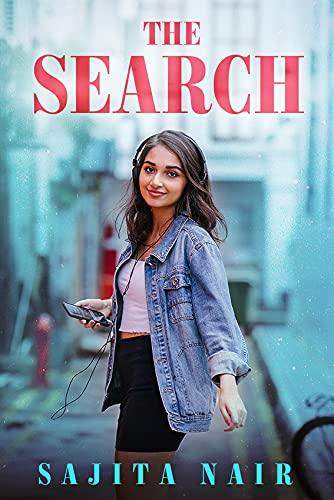
The Search by Sajita Nair


Title: The Search

Author: Sajita Nair

Publisher: Juggernaut

Format: Kindle edition 


The Search is the story of an eighteen-year old girl Laya who is portrayed as a regular vivacious girl of her age. Her doting parents, loving friends, a boyfriend and a fun-filled college life complete the picture of her life. A certain event in her life pushes her to take up the quest for her roots more seriously and urgently. As the story progresses, she comes across as a strong-willed person who decides to stand alone than to cave under societal pressures or norms. As she continues to walk on her chosen path, her loved ones join her and provide her the much needed support. While riding the emotional waves at various levels, she realises how going ahead with one decision brings her the wisdom to make peace with the situation of her biological parents.


The narrative is quite fast paced. The first significant turning point comes a little too soon but then the readers get hooked to that momentum. Story is engaging and as one keeps turning pages, one is actually hoping for the same happy ending where the author leads the readers to. Plot is not complicated and it is handled with ease as well. This story is about a young adult and for young adults. I like how author has attempted to highlight the significance of learning to take responsibility for the choices made. The new age young adults feel free and empowered to make choices and take their own decisions, but wisdom is in always remembering that some choices have life changing consequences. 


I remember reviewing Sajita's first book - She's a Jolly Good Fellow, more than a decade back. Not wasting anytime on frivolous characters and events in storytelling has been her forte which I really appreciate. Having said that, personally I was expecting a little more in terms of substance in whatever comes out of Sajita's pen. I will look forward to her next writing attempts for that. 


Tuesday, June 14, 2016

Rupa Publications Reviewed

Title : Ganesh
Author : Subhadra Sen Gupta
Illustrated by : Tapas Guha

Publisher : Red Turtle (Rupa)
ISBN : 978-81-291-4029-6

Thanks for beautifully illustrated children's books and movies on Ganesh, the Lord has become the most endearing and much loved friendly God for children. The stories behind his unique physical characteristics like pot-belly, elephant's head and a broken tusk - keep the children engaged to no end. While we all know the most popular stories associated with Ganesh, they are being retold by Subhadra Sen Gupta with a slight twist.

Though acclaimed as the most learned and witty divine being, yet the antics of Ganesh bridge the gap that a devotee feels with the divine. He is the adorable and friendly God for all, and the one who can be made happy by pure innocent love.

The book Ganesh has four stories - How Ganesh Lost his Head, Ganesh Loses a Trunk, Ganesh versus Kartik and Ganesh Curses the Moon. Each of the stories are beautifully accentuated by colourful illustrations by Tapas Guha.  A perfect gift to children of age group 5 to 8 years.

Available on flipkart


Title : The Story of Hanuman
Author : Mala Dayal
Illustrated by : Taposhi Choshal
Publisher : Red Turtle (Rupa)
ISBN : 978-81-291-3717-3

And who is the other God that incites the same feelings as Ganesh, none other than the monkey God Hanuman. Known for his unflinching devoutness towards his deity Sri Ram, the stories associated with Hanuman are equally amusing and awe-inspiring. When he was a child, he thought the shining Sun is some big juicy fruit in the sky and so leapt into the sky to pluck it. This led to a lot of chaos and many Gods had to intervene which made Hanuman's father the Vayu God very angry. The other Gods had to appease the Vayu God by bestowing special blessings and powers to Hanuman. When the time came to seek knowledge, Hanuman approached Surya to be his guru and in return Surya asked Hanuman to look after his son, the monkey prince Sugreev. Hanuman facilitated the bond of friendship between Sri Ram and Sugreev. He was entrusted with the task of searching for Sita in the south direction where Lanka is situated. He crossed the great ocean, met mother Sita, set Lanka on fire, brought the news of Sita to Ram. Soon after, the great battle began between Sri Ram and Ravan. Hanuman remained by the side of his Lord all through.

His devotion to Lord Ram is unparalleled. The whole story from the childhood of Hanuman to Ram-rajya has been retold by Mala Dayal in 'The Story of Hanuman'. While everyone is well versed with these mythological stories from the epic Ramayana, it is always interesting to read the same through the words of different authors. The added bonus that this book offers is extra trivia about names of different trees, and some activities like puzzles, mazes and games.

Available on flipkart


Sunday, October 11, 2015

Bala Gala the Brave and Dangerous by Gita V. Reddy

Title : Bala Gala the Brave and Dangerous
Author : Gita V. Reddy
Illustrations by : VC Arts


'Bala Gala the Brave and Dangerous' is a cute little story which celebrates imagination of tender minds as the main theme. Every child is a gifted dreamer, and the flights of imagination take him to far and wider places which may not even exist in the practical world.

There once was a Gamba-Bamba forest in which a river Kanga flowed. Bala Gala was a tiger in that forest who roared ferociously. Earlier he was a deer, who was quick and fast. There were many other co-inhabitants of the forests too. Brammy-Gommy, the crocodile who always wanted to eat Bala-Gala whenever he came to the river to drink water. Once when a monster came to the jungle, Bala Gala turned into a fire dragon to scare the monster away. In every flight of his imagination, he made many friends, scared some away, saved some but enjoyed every tryst thoroughly.

Yes, these are all imaginations of a little child who wakes up every day with a fresh adventure in mind. Just by imagining himself to be a different creature every morning, he weaves a unique world around it.

Role play is a great way by which little children learn and entertain themselves. The author has done perfectly well in reaching out to the children through their dreamland where they usually love to reside. In fact, the ability to be able to imagine oneself to be anything is quite empowering. One can choose to be anybody or anything and that is what Gita has allowed Bala Gala to be. He chooses to be a deer first but when Brammay-Gommay frightens him,  he decides to be a tiger instead. And on a beautiful bright morning he looks forward to being a pretty butterfly. There is no end to the options and hence the excitement is endless too.


Illustrations beautifully accentuate the impact of the story.

Wednesday, August 12, 2015

The India I Love by Ruskin Bond


Title : The India I Love
Author : Ruskin Bond
Publisher : Rupa 
ISBN : 81-291-0397-4


Ruskin Bond mesmerizes his readers yet again through his straight from the heart collection of prose and poems. This is his way of expressing his feelings for his beloved adopted country with all her animate and inanimate beings, their uniqueness, their character and how all these combine to create a unique flavour of Indian-ness.

In some chapters, he reminisces about his earlier days, the time when he decided to make India and specifically her hills his home and leave West for good. In his words, "The link with Britain was tenuous, based on heredity rather than upbringing.  It was more in the mind. It was a literary England that I had been drawn to, not a physical England. " 
He talks about the mountains and hills, rivers and its tributaries, various people and their idiosyncrasies.
He sprinkles the chapters with some nuggets of wisdom that he has processed over the years by observing people and his surroundings keenly.
"A well-balanced person : someone with a chip on both shoulders
Experience : The knowledge that enables you to recognise a mistake when you make it the second time
Sympathy : What one woman offers another in exchange for details
Worry : The interest paid on trouble before it becomes due"

His adroitness to write about himself with utmost sincerity and transparency becomes apparent time and again by the ease with which he packs self-mockery in his writings. His honesty and humility reach out to the readers unadulterated as he cloaks his feelings in simple yet effective language.  A slice of his humility and critical analysis of himself get reflected in these lines -
"I am not the most inventive of writers, and fantastical plots are beyond me. My forte is observation, recollection and reflection. "

Ruskin Bond's writings are so true to the soil of this country in its original form, it clearly displays his sensitivity in observing, experiencing, absorbing, imbibing and processing the Indian-ness in his system and what comes out through his pen is the essence of his relationship with the country and with everything belonging to it. 
The peace and serenity in his writings transport the readers to a blissful state of living the life in its entirety with every single moment registering its presence and with every single thing getting observed, acknowledged and appreciated in the same way as Ruskin Bond does on his solitary walks.
"I prefer walking alone to walking with others. That ladybird on the wild rose would escape my attention if I was engaged in a lively conversation with a companion. Not that the ladybird is going to change my life. But by acknowledging its presence, stopping to admire its beauty, I have paid obeisance to the natural scheme of things of which I am only a small part."

Whenever I get a chance to conduct interviews with the authors, I often ask them for their suggestions to the aspiring/budding authors. But without having directly asked Ruskin Bond, I got the answer from him in this book -
"If you, dear reader, have any ambitions to be a writer, you must first rid yourself of any notion that perfect peace and quiet is the first requirement. There is no such thing as perfect peace and quiet except perhaps in a monastery or a cave in the mountains. And what would you write about, living in a cave? One should be able to write in a train, a bus, a bullock-cart, in good weather or bad, on a park bench or in the middle of a noisy classroom.

While I was editing this review, I noticed that I have used so many of his quotes directly here. This clearly shows that no words are worthy enough to carry the essence of his writings and they are best as they are. 

Monday, January 26, 2015

Sita's Sister by Kavita Kane

Title : Sita's Sister
Author : Kavita Kane
Publisher : Rupa
ISBN : 978-81-291-3484-4

So  many questions keep flooding a thinking individual's mind, more so after reading thought provoking books like Sita's Sister. What is just, what is dharma, which is bigger - a role or an individual, where does duty of one end and the personal space of another begin, who decides which role takes precedence over another, does love mean being someone's weakness or strength, should love surpass duty or the other way round, and many more.

Kavita Kane brings to fore one of those characters of the epic Ramayana who have grossly been ignored by the center stage lights. Urmila is often remembered as one of King Janak's daughters, Sita's younger sister and Lakshman's wife.  Paeans have been written about the sacrifices of the prime characters of the mythology in whose shadow many characters have been eclipsed. Lord Ram smilingly renounced his right on the throne of Ayodhya to follow the promise that his father gave to one of his wives. His worldly consort Sita gave a glimpse of her fortitude by choosing the same path for herself as was destined for her husband. Lakshman chose to let his course get automatically sealed as he could not think of not being with his elder brother during the exile period of 14 years.  Bharat decided to spend the 14 years of Ram's exile in complete abstinence of all royal pleasures as a way of his penance. These are the towering embodiments of ideals in the epic story, but often, the larger than life sagas end up neglecting the contributions of some, who silently bear the consequences of others' decisions and promises. Their greatness lies in invisibly supporting the main players.

In Sita's Sister, Kavita Kane has lent that missing voice to Urmila. The title itself is extremely well thought out, true to the life spent over-shadowed and outshone. Here Urmila is portrayed as a delicately beautiful, spirited young princess who knows her mind and has no qualms in voicing it too. She is not the one who wants to live in illusion or any make believe world. She comes across as an individual who acknowledges and accepts her situations gracefully - whether it is of being a second fiddle to the adopted elder sister Sita or submitting to the fact that her husband would remain committed to his brotherly duties over and above her. But this does not push her down rather she reciprocates the favour by being a source of strength for her loved ones.

She displays the mettle and the fortitude to provide the anchorage to her family whether it was her parental one or later her marital kinship. She tries her best to sew the relationships and while doing so, she poses some very pertinent questions from time to time. Her voiced displeasure on Bharat's decision of spending the next 14 years in Nandigram is clear example of her confident and intrepid nerve. She questions his dharma towards his wife Mandavi - 'we have talked about all sorts of dharma - of the father and the sons, of the king and the princes, of the Brahmin and the Kshatriya, even of the wife for the husband. But is there no dharma of the husband for his wife?'

There cannot be any surprise on the plot front yet the narrative from the perspective of a different character makes it appear so very uniquely distinct.

Some other characters that make their presence felt significantly in the story are that of mother Sunaina and Lakshman. Though a queen, Sunaina is a mother first and wants happiness of her daughters even if it means disregarding the political bindings. The part where she confesses her conduct in front of Urmila, would surely touch readers' inner chords. 'Probably I expected too much from you. Or, because I felt you were mine, the daughter of my flesh and blood, unlike Sita or the motherless Mandavi and Kirti. That's why I was over-protective for them but harsher to you.'

Lakshman has always given an impression of being a person who is devoutly committed to his brotherly duties all through his life and his personal relationships and bonds never surface in prominence. But in Sita's Sister, he comes across as a person who is equally vulnerable and emotional as is any other individual. He also needs someone from whom he could derive his treasure of strength. To deliver on his lofty ideals, he depends on two women in his life - his mother and his wife. Separation from his wife is no less torturous for him either but he wants his 'Mila' to make it easier for him because he acknowledges what she is, in his life 'you are my strength but also my weakness'.

This story very strongly brings back the memories of MaithiliSharan Gupt's Saket, another must read by the connoisseurs of mythology and appreciators of subtle human emotions.

Kavita Kane's language has contemporary feel to it which makes the narrative more relatable for the present-day readers. Also, some of the questions that are raised in the narrative seem equally relevant. Personally I see nothing wrong in re-defining and re-analysing the age old mythology. I firmly believe that the way any story (epic or otherwise) is understood, analysed and presented has a lot to do with a myriad of factors - the time, and the prevailing mindset, customs and culture of that time. So when we experience almost complete metamorphosis of our society with time, perhaps mythology also looks for re-definitions from time to time. 

Cannot help quoting some pearls of wisdom from the book -

...when love surpasses duty, it is salvation.

Unhappiness makes us self-absorbed, it makes one think only of oneself- of the pain, and misery one is suffering.

Only with detachment one learns the value of love versus the range of emotions - exile from attachment. 

Tuesday, November 18, 2014

The Case of the Secretive Sister

Title : The Case of the Secretive Sister
Author : Nilanjan P. Choudhury
No. of Pages : 162
ISBN : 978-9383098552

Mr. Chatterjee is a middle aged man whose long experience in claims settlement for an insurance company has made him a confident candidate to open his own detective agency. His investigation skills do not get tested appropriately as the cases that he gets to work on range from lost documents, missing pets or runaway drivers. Not just that, the number of clients requiring his services have been 'as elusive as Dr. Manmohan Singh in a chatty mood'.

One fine day, Mr. Chatterjee gets a new client in an over-zealous mother, Mrs. Pammi Chaddha who does not want to give up after her four year old daughter Aisharadhya aka Pinky Chaddha (her 'home' name) has been denied admission in one of the most sought-after schools of Bangalore. She wants Mr. Chatterjee to make this daunting task of securing admission for Pinky in the same school, possible.

Though Mr. Chatterjee does not see any hope of succeeding in this case, he wants to give it a fair try. In order to do that he would have to confront the no-nonsense Sister D'Souza who is at the helm of her school as the headmistress. He devices his plans methodically which his smart secretary interprets as his approach to rectify his piles problem. What follow are, action packed pages high on cat and mouse, stalking, drama, comedy and much more. Well, what is a detective novel without any of these elements?

'The Case of the Secretive Sister' is the second book by the author Nilanjan Choudhury but he comes across as a seasoned author especially when it comes to the tautness of the narrative and the finesse in the language. Once the narrative takes a fast-paced turn, at no moment does the tempo slacken. His choice of characters is commendable, whether it is Mr. Chatterjee's secretary Ms. Jolly or Inspector Gowda. From the accented voices of characters, one can actually hear their respective 'native' (place) speaking. A true Kannadiga and Bangalorean, Inspector Gowda takes it personally upon himself to sanitize his beloved city of all - Chatterjees, Choudhurys, Chaddhas and Chaturvedis. 

When we are witnessing almost a dearth of true-to-genre books in the market, this book comes as a whiff of fresh air where intelligent comedy is served in its full glory. We are fast becoming a society where we seek maximum value for money which is exactly the case with books as well. We are being offered medley - comprising of various elements all together - comedy, romance, adventure, et al. 'The Case of the Secretive Sister' reminds one of the humour of the order that is penned by Bill Cosby, Bill Bryson and P.G.Wodehouse. It is a pleasant change from the comedies that have inundated the mainstream television and movies these days. If you are looking for a small, light and a hilarious read, don't miss this one. 

Monday, August 25, 2014

A Search in Secret India by Paul Brunton

Title : A Search in Secret India
Author : Paul Brunton
Publisher : Ebury Pr
ISBN : 9781844130436

Paul Brunton is one of the greatest explorers of the nineteenth century. Many of his writings address spiritual beliefs and traditions of the Eastern world. A Search in Secret India, his first book, is chronicling of his journey in the enigmatic land of India where he spent time with mystics,  yogis and holy men trying to unravel the mysteries of faith and spirituality.  Though he is open minded, he approaches things with scepticism and with a mindset of an intellect. He tries to evaluate things on his scientific and philosophical scale. He embarks on a quest to find the real Yogi but wants to proceed logically. In 'A Search in Secret India', Paul Brunton gives detailed accounts of meetings with various Yogis walking the path of spiritual growth, he also meets many who practise the art of magic and egotism. But then his sojourn eventually leads him to his destination when he finally meets the great sage Sri Ramana Maharishi. The last quarter of the book is dedicated to the time he spent in Ramana Maharishi's ashram in Tamil Nadu. Author feels that his experience at the ashram changed him completely.

As it is, tracking the origin of faith and spirituality in India is nothing less than an enigma. This book offers a great approach to begin to learn about the true changing facets of spirituality in India - critical and logical. With inumerable spiritual  branches and sub-branches sprouting from every possible corner, and materialism making the path to self realisation even harder, it is important to understand and experience spirituality in its truest form.

Paul Brunton's writings are very readable and easy to connect to. The pace of the narrative is a little slow in the first half but then one starts enjoying the tranquil and relaxed pace of the same. The book is set in 1930s and the narrative gives an idea of the supremacy that Britishers enjoyed in India at that time. It is wonderful to read how his journey culminates and that chapter is the highlight of the book. After reading it, one is at least able to get a small glimpse of the higher spirituality which stirs the inner yearning to seek the same.

"But it is not till the second hour of the uncommon scene that I become aware of a silent, resistless change which is taking place within my mind.  One by one, the questions which I have prepared in the train with such meticulous accuracy drop away.  For it does not now seem to matter whether they are asked or not, and it does not seem to matter whether I solve the problems which have hitherto troubled me.  I know only that a steady river of quietness seems to be flowing near me, that a great peace is penetrating the inner reaches of my being, and that my thought-tortured brain is beginning to arrive at some rest.  I surrender myself to the steadily deepening sense of restfulness until two hours have passed... I begin to wonder whether, by some radioactivity of the soul, some unknown telepathic process, the stillness which invades the troubled waters of my own soul really comes from him."

Wednesday, July 30, 2014

Interview : Priya Narayanan

An avid traveller, a voracious reader, a passionate designer, and a doting mother of two - Priya Narayanan believes that there are stories lurking around every corner, waiting to be captured and revealed to the world. Although she has long been a writer of short stories and poetry, it was just recently that she took up the challenge of writing for children. Her book 'The Moon Wants to be Spotless White' (reviewed here) has been well received by the young readers.

How did you pick the topic for your book - 'The Moon Wants to be Spotless White' and what all preparation did you do for penning down this story?

I’ve been in love with the moon from ever since I can remember. I love staring at it and thinking of all the different things it could possibly be, apart from the droning fact that it is a satellite. And I guess at some point in time or the other, every child is fascinated with that white dot on the night sky. So when I thought about writing for children, it didn’t surprise me that the Moon played an important part in my story.

It all started when I had to explain the dark spot on the moon to my tot. I was quite amused by her questions and decided to give her some amusing answers in return, doing away with stereotypes such as the old man or rabbit on the moon. Why couldn’t the spot be something as commonplace as a dirt patch splattered across the moon? That thought sowed the seeds from which the story eventually sprouted. My challenge was to take that very ordinary explanation and turn it around into something extraordinary.

Frankly, I did not prepare much before putting my thoughts on paper. The moment the story took shape in my mind, I ran for pen and paper and wrote it all down at one go, lest I’d forget some part! Of course, by ‘wrote it all down’ I mean the basic idea, which served as both the outline and the spine of the story. Then came the crucial part of developing each scene and character to appeal to the target audience - after all, there is a great difference between conjuring a story for your child at bed-time and writing a story that could be read and enjoyed by children all over the world.

In 'The Moon Wants to be Spotless White', there are three main characters – the Moon, Mitu and Dhobi kaka. I found it immensely enjoyable to personify the Moon and add little nuances to his character that children could find amusing. I particularly enjoyed writing the part where he is folded and waiting in Dhobi kaka’s jhola – all eager to spring out and get a good scrub.

Similarly, I have tried to work out every little detail about the other two characters, be it Dhobi kaka’s looks and background or the nuances of Mitu’s dreamy character. I was also very clear at the outset that I wanted to set the story in a village or small town. I guess it has to do with my own fascination with the flavor of life in small towns – the landscape as well as the community where everyone knows everyone else and even small incidences are blown out of proportion, sometimes to comic effect.


How has been the response to your book? Are you satisfied with it?

The response to the book has been very encouraging. Complete strangers have picked up the book and have sent me mails saying how much they loved it. That is the wonder that the internet is!

What caught me by surprise was that adults too enjoyed the book as much as their kids did. They have also loved the beautiful sync between the story and illustrations. So yes, I’m quite satisfied. It is altogether another matter of course, that this being my debut book, I still have to learn the ropes of promoting the book better to ensure a wider reach.


Are there any sections that you'd want to change in 'The Moon Wants to be Spotless White'? Why?

While life is all hunky dory when you write just for yourself – like I do with my poetry - one has to keep an open mind and accept criticism when you write to be read by others. The answer to whether I want to change any portion of the book would be both Yes and No.

Yes, because when a reader points out a problem area, it would be too pompous on my part to ignore it. I place a great deal of value on constructive criticism. No, because this was the story I set out to tell and changing it would mean not staying true to the seed idea. It is a double-edged sword and a tough call to take at the moment. But there’s one thing I know for certain - I’ll incorporate all the feedback I have received from this book into my upcoming one and ensure that I’ll be in less of a dilemma the next time over.


What ambition do you nurture in terms of writing books for children?

Quite frankly, I did not set out to be a children’s author. It just so happened that my first published work is a book for children. I have been writing poetry ever since I remember and somewhere along the way, I also branched into writing short stories. I have a good collection of poems that I hope to compile into a book of verse some day.

That said, my interactions with children who have read ‘The Moon wants to be Spotless White’ have given me the urge to write more for them. My own children have also been a great source of inspiration – whenever I spin a new tale for them, they ask me in all innocence if I’d be getting that story published too. I wish it were as simple as that!

But yes, I guess I can safely say that I will not stop writing for children. In fact, I already have another book in the pipeline for 5-8 year olds and the first drafts for a couple of short stories for tweens. I wouldn’t call it an ambition; just plain old love. I find children to be non-judgmental and writing for them is very gratifying.


How do you find the kidlit scene in India as compared to its foreign counterpart? Which all changes would you want to see in this sphere?

Growing up, there really was no kidlit scene in India. Or rather, the kidlit market was all about imported titles. However, now,  publishing houses are waking up to the vastly untapped readership for books by Indian authors and the result is a slew of children’s books written in English as well as various Indian languages that bring in a veritable mix of stories, allowing children to explore our country and its diverse cultures. But a lot remains to be done.

Even today, when I walk into a Crosswords store, I can see a pile of foreign titles on highlighted display stands, whereas books by Indian authors – even Ruskin Bond for that matter, are relegated to the quieter racks at the rear. This rather saddens me. While I’m not averse to foreign titles, I feel that there is a need to promote vernacular stories that afford children a context that they can immediately relate to. I would also like to see a more proactive role of publishers and bookstores in promoting Indian kidlit because just publishing a good book is not enough– the book ultimately has to have visibility and reach the hands of as many readers as possible to make it a meaningful venture for all involved.

Another question that one needs to look into is how much is the penetration of kidlit in small-town and rural India today? I would love to see more and more foreign as well as Indian titles in English being translated into regional languages and being made available in every small town in our country.


In which way and in what sense would you want to make a difference in the children's literature?

That’s a googly, really! I don’t know if the stories I write will make a difference in children’s literature – and I’m quite sure no author sets out to write a book with the purpose of changing the literary landscape. What I really aspire is to write stories that nobody has heard of before, write stories that will elicit a chuckle from a child or bring a smile to his/her face.


How has been the journey of being an authoress so far? What is the biggest joy of being one?

I have enjoyed the entire process that saw me grow from being someone who wrote solely for self-consumption to being a widely read author. What started with a whole load of anticipation has culminated into a feeling of exuberance and contentment. Also, the appreciation that has come my way has encouraged me to take more risks with my writing.

The biggest joy of being a writer, of course, is being able to communicate with readers from across the world through the medium of stories. After all, stories are the simplest way to get your message across to another person, aren’t they? Another plus is that I get to do what I love to do most, i.e. writing, minus the guilt trips.


What is your dream story? Do you have any in the pipeline?

I guess my dream story is yet to be dreamt! But really, I have not given this a thought. I am a very impulsive writer. Be it my poems or stories, I do not decide that I have to write about such and such a topic and go about it in a disciplined fashion. I am a keen observer of things, events and people around me and as I said before, I run around looking for pen and paper whenever an idea strikes me. These days, the Evernote app on my phone comes in handy.

I do have another book in the pipeline. This one is also an illustrated story for 5-8 year olds. It deals with the topic of death in the family and I have tried to approach the subject with a lot of sensitivity. I hope readers will receive it with as much enthusiasm and love as they have given my debut book – The Moon wants to be Spotless White.


Which kind of books do you enjoy reading yourself? Who are your favourite authors?

I hope you don’t regret asking me this question, ‘coz it has given me a license to rattle off big names.

While I read almost every kind of book, both fiction and non-fiction, I enjoy reading the classics the most. During my school and college days, I’ve also enjoyed courtroom dramas and crime thrillers to a point of saturation – today, I’d rather see an investigative serial on TV rather than read a book about it. One genre that I don’t find myself drawn to is that of Romance. It’s not that I don’t like romance per say. I’d rather enjoy it as subtle part of a bigger picture than romance taking over every page of a book and choking me with all the mush!

My favourite author has constantly changed to keep up with my growing years. However, during and after graduation, I came across and read a slew of authors – many of whom have made a deep impact in my world-view as well as belief systems. Bertrand Russell, Kafka, Hemmingway, Joseph Conrad, Joyce, Herman Hesse, Gabriel Garcia Marquez, Irving Stone, Nobokov, Graham Greene, Orhan Pamuk . . . I can’t even begin to list them here!

It is indeed a task to choose one favourite, but given my love for the classics, I’ll pick Fyodor Dostoevsky. I have loved all of his work without exception – I even like the way he tackles romance. Amongst Indian authors, I love the short stories by Kushwant Singh and Ismat Chughtai as well as Ruskin Bond’s books for both children and adults. Finally, Walt Whitman wins hands-down amongst poets, with Ogden Nash coming a close second.


 Any tips that you'd want to pass on to the new authors?

I guess I am too new an entrant in this space to be advising others, but yes there are a few things that I’ve picked up along the way, which I’d like to share.

  • Don’t get entangled in the web of everyday routine and push your literary pursuits to another day – if you love writing, just find the time to write by hook or crook.
  • Don’t write to get published, write because you love to do so – the publishing aspect will surely follow.
  • Keep honing your skills as a writer – never make the mistake of thinking you know it all

Monday, July 14, 2014

Done With Men by Suchi Singh Kalra

Title : Done With Men
Author : Suchi Singh Kalra
Publisher : Indireads

'Done With Men' is a light romcom set in the beautiful locales of Goa. Kairavi (Kay) is a weirdly interesting character as the main protagonist who is done with dealing with friends of opposite gender. She resolves never to get involved with any man in future and in the moment of desperation she gets 'Done with Men' etched on her skin as a tattoo. But the love bug does not follow any rules, and it bites her again when she happens to come in contact with Vivian, an Orthopaedic in the hospital. She finds herself falling in love with him in spite of her earlier firm determination. Still recovering from her last heart break, Kay is admonished and advised by her best friend Baani and the pesky Thought Bubble. Kay is back on an love adventure ride.


The characters etched by the author are easy to identify with. Their vulnerabilities, weak moments and imperfections make them very real. The interactions between Kay and Baani are quite believable. Good thing about these IndiReads' novellas is that one can finish them in one sitting. Though there are many Hindi words used in the narrative but the translated words of the same have been provided at the end for the benefit of non-Hindi speaking people. A light, fun and quick read to brighten up any day. The light and breezy language would go well with young adults too. The narrative is laden with humour and wit which keep the readers engaged right from the beginning till the last line. This could easily have been extended with more interesting incidents and anecdotes, but author has not extended the story unnecessarily. Though the narrative takes some very predictable twists and turns but readers would surely enjoy this innocent, short and sweet love story.

Sunday, June 22, 2014

Mistress of the Throne by Ruchir Gupta

Title : Mistress of the Throne
Author : Ruchir Gupta
Publisher : Srishti Publishers and Distributors
ISBN : 9789382665076


Mughal period is one of the periods that keeps beckoning authors of almost every generation to come back to it to unravel the mystique behind the opulence that this era was known for. Though the royal emperors - Akbar, Jahangir, Shah Jahan, Aurangzeb have long been resting in the annals of history, yet their styles, their sensibilities for art and culture, their harems, food, generosity, ruthless machinations and brutal lust for power - entreat many to dig deeper. Many books written by contemporary authors like William Dalrymple and Indu Sundaresan have already been reviewed here on Literary Sojourn.

'Mistress of the Throne' picks a small timeline starting from the year 1631. This was the year when the beloved queen Mumtaz Mahal, of emperor Shah Jahan breathed her last during one of the childbirths. Going against the tradition of passing the title of Queen to one of his other wives, Shah Jahan chose to anoint her eldest daughter Jahanara with this royal honour. The new seventeen year old queen found herself shouldering responsibilities on personal, familial and public fronts. She dedicated herself to keeping the family united but her efforts fell short in front of towering egos, jealousies and scuffles for supremacy and power. The power tussle between the extremist Aurangzeb and the mild tempered Dara was apparent right from the very beginning of their getting together. Though Dara Shikoh was the favoured son of emperor Shah Jahan and was the heir apparent, he lost his life in a bitter battle with Aurangzeb for the imperial throne.

Mistress of the Throne is the first person account of Jahanara through which readers are given a peak into the functioning of Mughal empire and the political games that were played on either sides of the veils. Author Ruchir Gupta sensitively brings out the inner turmoil that the young queen went  through when she understood the implications of the harsh reality of living life alone. Though she very closely witnessed the love between her parents which Shah Jahan tried to immortalize in the form of Taj Mahal, she knew she would never be able to experience that emotion all her life. Her only fault was that she was a Mughal emperor's daughter.

Ruchir Gupta has done a commendable job in bringing back the bygone era intricately in the book. The scene setting is done in such a way that one becomes a part of the fast paced and engaging narrative. Language is simple to follow and flows lucidly. The characters are built slowly but with utmost care, especially that of Aurangzeb. The ruthlessness and fundamentalist attitude of Aurangzeb is very well documented in course books and other texts but this is the first time that one gets see and understand his personal side as well. Spending his childhood in a hostile exile, away from the love and warmth of his benevolent mother scarred his soul. Unfortunately he did not get much time with Mumtaz Mahal to savour the essence of unconditional affection and love. His insecurities, vulnerabilities and yearning to be the good son and good brother touch the chords at various places as the story progresses.


As far as the character building of Jahanara is concerned, Indu Sundaresan's adaptation wins over Ruchir Gupta's. Had I not read any of the books written by Indu, I would have enjoyed reading 'Mistress of the Throne' without any comparison in mind. But the images of Mughal queens that Sundaresan creates in her Taj trilogy remain firmly etched in the readers' minds and any other replacement will run the risk of appearing wane in comparison. They are just a tad short of flesh and blood otherwise she has done all to breathe life in the characters. Well, there is a difference in portraying a woman and being one.

The book was sent to me by


Monday, April 14, 2014

Beyond School by Chitra Anand

Title : Beyond School
Author : Chitra Anand
Publisher : Leadstart Corp
ISBN : 978-93-83562-40-4

The author, Chitra Anand is a postgraduate in Physics and holds an Education Degree. Beyond School is her first novel inspired by her journey as an educator.

'Beyond School' story revolves around a grade twelve student Shail at an Indian School in Muscat. As countdown has begun for his board examinations, his parents Sushil and Urmila are at their wits ends. They cannot find any way to convince their son to study for the board exams while Shail leisurely goes about doing his other activities, which include - sleeping with abandon, dreaming about football or his girlfriend, watching re-runs of football matches on TV, texting on mobile phone for hours and much more. In short, a typical day in his life does not have any scope to accommodate study time. However, what Sushil and Urmila are unaware of is Shail's decision to not appear for the exams at all this year.

As the story progresses and as the examination days are approaching nearer, the pressure is soaring high for Shail to escape from his parents' focus and for his parents to make Shail study. Glady, the mentor in the school is approached for Shail's situation. She has a way of showing the students the side of the picture that they seem to be unaware of. She is a great counselor without being preachy. Her way of dealing with such situations is to get the student understand why and how a particular fixation of mind and heart starts driving the decisions and when that fixation is satisfied, how the pressure fizzles out. 'Tell people that they can have what they want and soon their fight for the want loses intensity.' She gives a new dimension to Shail's thinking so that he does not stay stuck with 'What is wrong if I don’t write the exams this year?'

 A few more sub-stories are intertwined along with Shail's narrative, including that of - Glady's uncomfortable past, Sushil and Urmila's struggle to get united and Roha as another student requiring Glady's counseling.


Chitra Anand highlights many areas that have gained immense significance in the lives of individuals who are at the cusp of adulthood. The unrestrained  access to information, gadgetry invasion, unabashed approach towards sexual issues and much more are subtly weaved into the fabric of the narrative. This gives an honest reflection of the society in which today's youth is functioning. Though an amateur author, Chitra has done justice to the idea that she wanted to convey through her writing. However, there are a few places where editing could have been more tight. Some of the incidents are unnecessary or too elaborate which could easily be done away with. 
A recommended read for young adults and their parents. 

Tuesday, December 17, 2013

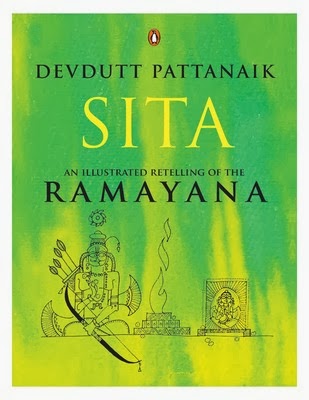
Sita by Devdutt Pattanaik

Title : Sita
Author : Devdutt Pattanaik
Publisher : Penguin India
ISBN : 978-0-143-06432-9

"You judge him but I love him Lakshman. You see your brother as an ideal and are angry because he has not lived up to your expectations. I see my husband for what he is, and understand his motivations; at every moment he strives to be what he thinks is best. I will not burden him with expectations. That is how I make him feel loved. And he sees me, knows that I will support him no matter what, even when he resorts to such devious route like an errant child."

Sita watched Lakshman's nostrils flare. She felt his embarrassment and his rage. She wanted to reach out and reassure him, but she restrained herself.
'You feel your Ram has abandoned his Sita, don't you?', she asked gently.
'But he has not. He cannot.
He is God - he abandons no one.
And I am Goddess - I cannot be abandoned by anyone.'
A mystified Lakshman returned to Ayodhya, while Sita smiled in the forest and unbound her hair.

Ramayana is an age old saga that has been passed on from generation to generation through two primary means of communication - maukhik (orally) and likhit (written). Another medium got added to the list much later - that of moving pictures, and this has been utilized multitude of times in narrating the epic tale. But perhaps Devdutt Pattanaik's Sita, is the one, which has touched me in a way no other could. Unlike Mahabharata, Ramayana is considered to be a much simpler tale with lesser diversions and sub-tales, but here in Sita, you get all that there is to read and understand about the story of Ram - the seventh incarnate of Lord Vishnu. The supporting tales mentioned here, do not hinder the flow of the narrative, rather they are brought out at the most logical junctures where they actually belong. Quite like what was done in Jaya, the author tries to bring many sub-stories, regional twists and beliefs into the fold of the main legend. The action of Ravana is compared and contrasted with some Greek and Roman mythological figures as well.  Furthermore, there is perfect dose of analysis and commentary part in the narrative which makes 'Sita' an introspective piece of writing.

In order to stay true to the title 'Sita', the author has attempted to bring a woman's perspective in the proceedings, which has been left unregistered by the earlier story tellers. It begins with Sita's early years in her maternal house. We have been generously introduced to the childhood period of Rama and his three bothers, however, there is not much that has been written about Sita as a child. The things that interested her, her pastimes, her relationship with her parents, sisters and others in the kingdom - do not find much of a mention in many writings. Here, she is portrayed as a well-read, wise, strong and confident character. It is amazing how filling colours in a pencil sketch takes the whole creation to a completely different level and that is what happens to the character of Sita. Pattanaik also highlights the relationship that Sita shared with other women characters - the queens of Ayodhya, Anusuya, Mandodari and Trijata. Their conversations make it easy for the readers to understand the personalities and thought process of various actors. 
The unmentioned and unacknowledged trivia may seem insignificant from the perspective of moving the story forward, nevertheless, they do wonders in giving a substantial identity to each character.

Though a religious epic, Ramayana is a story which leaves many wondering and questioning about the fairness and rightfulness of the decision taken by Ram in banishing his pregnant wife. In Sita, Devdutt Pattanaik has tried to address this sensitive issue by highlighting the divine connection that Sita had with Ram, and vice-versa. Sita tried to pacify the embarrassment of Lakshman thus - 'Ram is dependable, hence God. I am independent, hence Goddess. He needs to do his duty, follow rules, and safeguard reputation. I am under no such obligation. I am free to do as I please: love him when I am separated from him, love him when I am rescued by  him, love him when he clings to me, love him even when he lets me go.' This makes Sita a highly magnanimous person and one worthy of everyone's admiration and adulation.

Devdutt Pattanaik has the acumen to bring out the untapped wisdom that is lying deep in the mythological stories of yore. After having read Jaya and Sita, one wonders, how much there is to learn from such epic tales, if one could just acquire perception like that of Pattanaik.

I cannot put a final full stop to this review before I quote a few nuggets of intellect that would make one introspect and contemplate over and over again. 

  • Kanyaa-daan - I give you Lakshmi - wealth, who will bring you pleasure and prosperity. Grant me Saraswati, wisdom. Let me learn the joy of letting go. In daan only wisdom is asked in exchange, unlike dakshina - where wealth is asked in exchange and bhiksha, where power is asked in exchange.

  • Before your wife came into your life, you were a student, with no claim on property. After your wife leaves your life, you must become a hermit, with no claim over property. Only as long as she is by your side do you have claims over wealth. Without her, you cannot perform yagna, you must  only perform tapasya.

  • From desire come all problems and all desires come from fear.

  • What we possess is temporary but what we become is permanent.

  • Most people seek to be the sun around which the world revolves. Very few are willing to be the moon, allowing others to be the sun, despite having full knowledge that they can outshine everyone else. Ram's brothers served him to upholds the integrity of the royal clan. Sita was bound by wifely obligations but only Hanuman did so out of pure love. That is why Ram held him closest.


Tuesday, December 10, 2013

Only One Life To Give by Arun Kaul

Title : Only One Life to Give
Author : Arun Kaul
Publisher : Frog Books
ISBN : 978-93-82473-76-3

Arun Kaul opens a window and invites readers to peak into the life that he lived, through a set of short stories. The stories are wisely categorized under four sections. While 'Touching the Sky' has anecdotes from his professional life, some personal experiences are being shared in 'Within the Family'. The other two sections : 'Strangers in the Fold' and 'Women - What it Takes' bring to us some memoirs from the lives of other individuals. Same strings hold all these tales together - the strings of life values, inspiration, dedication, emotion, compassion, sincerity and empathy. Readers get an interesting opportunity to meet - philanthropy personified, a free spirit defying every shackle thrown her way, an individual embracing extreme atonement for his sin, a great administrator-facilitator-patriot, enormity of a mother's sacrifice, uprightness of a villager; and many more. 

We all create and become a part of many stories as we live our lives and when we look back these accounts appear prominently on the screen of our memories. Arun Kaul has collected these images from his memory screen and weaved them beautifully into a series of tales in 'Only One Life to Give'. 

Personally I liked the first section of the book the most. Although the personal section 'Within the Family' should have touched the heart strings the most, it falls short of doing so. Chronology of some events are described repetitively at various places which pushes the narrative to the drab side. Moreover, the abruptness of the personal story of mistrust and betrayal is sure to leave readers with bad taste
in the mouth.  Barring these two downers, the rest of the stories are a delight to read.

A post-graduate in Literature and Management, Arun Kaul made a career in Indian Air Force, followed by working in private sector in various capacities. More on him here.

Monday, November 11, 2013

Dare To Run by Amit Sheth

Title : Dare to Run
Author : Amit Sheth
Publisher : Sanjay Publisher
ISBN : 9789380392127

Amit and Neepa Sheth, the husband-wife duo took up running in their later 30s. In 'Dare to Run', Amit takes us through his journey from being a typical couch-potato to the one who made it to the finish line of the Ultimate Human Race - the 89 km Comrades Ultra Marathon in South Africa. It is a story of dreaming big and making those dreams a reality by sheer determination and perseverance. With that kind of focus and hard work, nothing seems impossible and Amit's life is a live example of the same.

In his own words, 'I loved all sports as long as I was watching them on television with a glass of beer in my hand!' While watching 2005 Standard Chartered Mumbai Marathon sitting cozily on his favourite couch, the festivities of the occasion enticed him to make a resolution that he would be a part of this festive atmosphere the following year. But the resolution slipped out of his mind almost the same day, to be revived after over six months and that was the time when he openly confessed his desire to his family. 

The first 200 m jog on the beach in Mumbai gave him a fair idea of the arduous task that he had committed himself to. But he followed the path that he had chosen and did it relentlessly. Dare to Run chronicles five years of the incredible journey that Amit undertook passionately and which eventually turned out to be a sojourn of tenacity, courage, discipline, self-belief and self realization. As one reads through the book, one realises how a strong drive to achieve something makes everything else fall in place and brings perspective in life. Once having made a beginning Amit kept on running to cover many milestones and conquer many finishing lines, however, this turns out to be a journey within himself. He had the privilege of having a great partner as Neepa Sheth in life and in running and throughout the narrative he talks about her strong, positive and encouraging presence by his side always. Amit brings in his poetic and philosophical flare of writing as he talks about time management, training regimen, injuries, failures and successes.


Dare to Run is much more than a book dedicated to running. Whether one is a beginner or a seasoned player in any discipline or field, Dare to Run is a great inspirational book to read. It motivates you to push the limits and watch the bigger and wider vistas opening in front of you.