Showing posts with label India. Show all posts

Friday, November 13, 2020

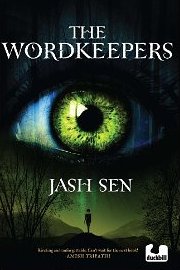
THE WORDKEEPERS by JASH SEN


Author: Jash Sen
Publication: Duckbill
ISBN: 978-93-82618-16-4
Price: INR 225

The book begins with an account of some war. This is followed by a letter from Vibhishan, the immortal king of Lanka and the brother of Ravana, of the time of Lord Rama.

A normal life of a regular busy teenager of the year 2028 is thrown topsy turvy when she receives strange messages from her mother and notices that her father's body casts no shadow in the mirror. A very strange sequence of events make her realize that she is no ordinary human, but the child of a 'wordkeeper' and is expected to live up to and act as per a prophecy. And she must rescue her mother.

Through the journey, she meets many people, who have, in their existing forms or their earlier incarnations, been characters from the great Mahabharata or the Ramayana. She discovers that she herself had been one.

Meanwhile, in the other world, in the world of the the nemesis of these wordkeepers, a handsome plan is being hatched to ensure that relevant information is collected and a trap is being laid upon the wordkeepers. This world is headed by God 'Kali'(not Goddess Kaali), the forth yug of the Hindu mithology. He has in his control, all the vices, the personifications of foul acts and all the existing demons and aims to become the sole God of the humanity.

A string of trustworthy friendships, bitter betrayals, family union, happy and sad phases, lead the teen-aged girl to discover something more about herself and take her a little further on the journey prescribed for her. And eventually, what has to happen, happens!!

An enormous eye keeps a track of all of her activities, until just before the end. 

It is interesting how the story, a very very common story of a child suddenly discovering his/her special powers (much like the characters of Harry Potter, Lexi , Henrietta and so many more in the contemporary fiction arena) is mixed with the complex story of the Hindu mythology, with a twist that incorporates all the other religions. (Kaalki, the last avatar of Lord Vishnu, is depicted through a Muslim boy here). Though the concept is brilliant and the author has done her homework really well, the final outcome falls short of the expectation that such a storyline would ideally demand. The theory of the child discovering gifted abilities has become too commonplace and childish to carry the heavy wight of the mythological tales. Though a racy narration, it becomes hard to convince oneself to read on and it gets too complex and ambiguous at places. 

A point I liked about the book is how the people, especially those of the other world, the Vishasha have been named. Dambha, Mrityu, Bhay, Vyadhi, Jara, Trishna, Shoke, Krodhe and so many more are basically the personified versions of the vices and problems we all face. For someone with a decent base of mythological knowledge, all this seems good, for others, it would have been better had a detailed glossary been give at the end.

A first of the trilogy, I think it is a fairly decent job. I hope the other two books are nice and make up for the loopholes in this one.

Wednesday, August 31, 2016

RUPA PUBLICATIONS: Man Eaters of Kumaon by Jim Corbett

Read a page from this book. Close your eyes for 2 minutes. Read another. Close your eyes again. Repeat this, until the chapter you've been reading is over. No wildlife based television show would ever be able to provide you with a better and more enchanting view of the life of hills and around of long ago, under the menace of dangerous man-eaters, like this one.

'Enchanting' be the one word, if I am to describe my thoughts upon reading this book.

This book is a compilation of ten tales of Corbett's various escapades, mostly spine-chilling, with tigers and leopards, who had gained notoriety due to being man-eaters. Having dealt with wildlife over a long period of time and having observed them from close quarters, Corbett has been able to outline the possible thought process or the reason for the beasts’ behaviours almost as deftly as he has been able to describe the human reactions and responses to the former’s threats.

As a reader, my personal favourite certainly is the story “Robin”, which in some sure sense resembles a typical work of Mahadevi Verma, delicately and lovingly outlining the life of a favourite pet. The protagonist of the story is Robin, Corbett’s faithful spaniel, who had accompanied and helped the author in many of his hunting adventures. In his own words, the canine was “the biggest hearted and the most faithful friend man ever had”. From how the pet came into the care of the author, to how he started training, to how his skill oftentimes became their savior, to how eventually, he bid adieu to his loving master, it is a beautiful story that leaves the reader yearning for more.

As Ruskin Bond aptly puts in the introduction, “Corbett’s exploits brought him fame as a hunter. His book turned him into a legend.”

If you consider yourself an adventure lover or are simply looking for some thrilling stories, here’s the deal. Just read this book. 

Saturday, July 9, 2016

RUPA PUBLICATIONS: My Favourite Nature Stories by Ruskin Bond

Title: My Favourite Nature Stories
Author: Ruskin Bond
Price: INR 195
Genre: Non-Fiction
ISBN: 978-81-291-3768-5


The sure worst part of the book was that it eventually got over. Each word devoured and each page gulped. I am still in denial and start re-reading every now and then, and yes, coming back to it is one of the best feelings ever.

Brought out by Rupa Publications on the occasion of the author’s 82nd birthday, this wonder of a book is a beauteous collection of 21 nature and daily life inspired pieces of prose by Ruskin Bond. To explicate why I refer to it as wonder of book, may I point that it had I, a self-proclaimed, hard hearted detractor of non-fiction genres, loving each of its stories and longing for more… and yet more.

Each of the stories is short, more like a compilation of penned down thoughts at different points in time during the author’s long association with the mountains and of brief periods away from them. The stories are straight from the heart pieces and the narrative is so real that as one reads them, one can totally imagine oneself as actually being in the place and situation described.  

From trees to insects to a walnut thief grandmother to the ancient wells of old Delhi to birds that sang and flowers that bloomed and snakes that didn’t kill to what humans are doing to the mountains to the tube train journey that could remind the author of mountain bears making away with ripe pumpkins, the book takes the reader though a variety of topics and places. And suddenly, somewhere in between the text, when you least expect, a funny line or two crops up. For instance, in the context of sweltering heat of the dusty lanes of Old Delhi, the reader gets to sample this:
“Shopkeepers nod drowsily beneath whirring ceiling fans. The pavement barber has taken his customer into the shelter of an awning. A fortune teller has decided there is nothing to predict and has fallen asleep under the same awning.”

There are some important lessons for us humans as well, case in point:
“While the green-backs took their plunge, the red-heads waited patiently on the moss covered rocks. I thought they showed more discipline than a crowd of people at a city water-tap.”

And some food for thought, like:
“For every time I see the sky, I am aware of belonging to the universe rather than to just one corner of the earth.”

The book also talks of how simple things like sweeping the verandah or meeting the river or the sound of some insects could be of importance and a source of happiness.

All in all, a very satisfying experience reading the book. A must read for all who’ve been to the mountains and cherish the calm inspired mountain life.


Although, I would request the publishers to get the book proofread as there are a few errors here and there, I would like to thank them for their praiseworthy endeavour in bringing out this book.

Wednesday, August 12, 2015

The India I Love by Ruskin Bond


Title : The India I Love
Author : Ruskin Bond
Publisher : Rupa 
ISBN : 81-291-0397-4


Ruskin Bond mesmerizes his readers yet again through his straight from the heart collection of prose and poems. This is his way of expressing his feelings for his beloved adopted country with all her animate and inanimate beings, their uniqueness, their character and how all these combine to create a unique flavour of Indian-ness.

In some chapters, he reminisces about his earlier days, the time when he decided to make India and specifically her hills his home and leave West for good. In his words, "The link with Britain was tenuous, based on heredity rather than upbringing.  It was more in the mind. It was a literary England that I had been drawn to, not a physical England. " 
He talks about the mountains and hills, rivers and its tributaries, various people and their idiosyncrasies.
He sprinkles the chapters with some nuggets of wisdom that he has processed over the years by observing people and his surroundings keenly.
"A well-balanced person : someone with a chip on both shoulders
Experience : The knowledge that enables you to recognise a mistake when you make it the second time
Sympathy : What one woman offers another in exchange for details
Worry : The interest paid on trouble before it becomes due"

His adroitness to write about himself with utmost sincerity and transparency becomes apparent time and again by the ease with which he packs self-mockery in his writings. His honesty and humility reach out to the readers unadulterated as he cloaks his feelings in simple yet effective language.  A slice of his humility and critical analysis of himself get reflected in these lines -
"I am not the most inventive of writers, and fantastical plots are beyond me. My forte is observation, recollection and reflection. "

Ruskin Bond's writings are so true to the soil of this country in its original form, it clearly displays his sensitivity in observing, experiencing, absorbing, imbibing and processing the Indian-ness in his system and what comes out through his pen is the essence of his relationship with the country and with everything belonging to it. 
The peace and serenity in his writings transport the readers to a blissful state of living the life in its entirety with every single moment registering its presence and with every single thing getting observed, acknowledged and appreciated in the same way as Ruskin Bond does on his solitary walks.
"I prefer walking alone to walking with others. That ladybird on the wild rose would escape my attention if I was engaged in a lively conversation with a companion. Not that the ladybird is going to change my life. But by acknowledging its presence, stopping to admire its beauty, I have paid obeisance to the natural scheme of things of which I am only a small part."

Whenever I get a chance to conduct interviews with the authors, I often ask them for their suggestions to the aspiring/budding authors. But without having directly asked Ruskin Bond, I got the answer from him in this book -
"If you, dear reader, have any ambitions to be a writer, you must first rid yourself of any notion that perfect peace and quiet is the first requirement. There is no such thing as perfect peace and quiet except perhaps in a monastery or a cave in the mountains. And what would you write about, living in a cave? One should be able to write in a train, a bus, a bullock-cart, in good weather or bad, on a park bench or in the middle of a noisy classroom.

While I was editing this review, I noticed that I have used so many of his quotes directly here. This clearly shows that no words are worthy enough to carry the essence of his writings and they are best as they are. 

Monday, November 19, 2012

Manto by Sadan Hasan Manto (Translated by Aatish Taseer)


Title : Manto
Author : Sadan Hasan Manto (Translated by Aatish Taseer)
Publisher : Random House India
ISBN : 978-8-184-00144-0

The author Sadan Hasan Manto born in undivided India donned many hats ranging from being a radio and film scriptwriter, journalist to a short-story writer. Though his short stories created many controversies yet he is acclaimed as one of the greatest story tellers of his times. In Manto's words, "If you find my stories dirty, the society you are living in is dirty. With my stories, I only expose the truth." Originally written in Urdu, his short-stories have been translated by none other than an accomplished writer himself - Aatish Taseer. Perhaps this is the reason that while reading this translation I never felt the missing link which usually the regular translations suffer from. The language is great and even though I have not read the original Urdu stories, I still could enjoy the details and nuances as would be done while reading classics of seasoned authors. So my compliments to Aatish Taseer that he brought the works of Manto to wider audience.

After reading these short stories, the most significant thing that could be said about the writing is that - his stories carry much more beyond the written text and understanding what is written between the lines make the stories and the story teller tower higher than the crowd.

Manto's stories introduce the readers to the realities of life and there are times when the reality is not very pleasing for the eyes and otherwise. Since his writings are around the time of partition, they do carry a somber mood and pessimism to a certain extent. This book brought back the memories of the writings of Khushwant Singh, Gurcharan Das, Gulzar and likes of them. Manto's writing has similar sensitivity and emotional aspect to them whether it is about : 'Toba Tek Singh' - a lunatic caught in no man's land, 'The Last Salute' which depicts friends turning into foes, child prostitute in 'Ten Rupees', cultural boundaries in 'The Mice of Shah Daulah' or the plight of a father after seeing her lost daughter in 'Khol Do'. Every tale stirs many deep seated strings within the hearts of the readers and I consider that an achievement of the storyteller.

The stories are set mostly in North western region of India which bore the brunt of partition the most. These 11 sensitively written stories explore those aspects of some lives which usually are left unspoken and un-talked about. In spite of belonging to conservative era, Manto did not hesitate to write about sensitive subjects so his writings were much ahead of his time. Usually women centric, the stories bring out the aspects which go beyond the realm of rationality and logic. These perceptive short stories would surely keep haunting the readers in times of non-activity.

Wednesday, July 18, 2012

A Flight Of Pigeons by Ruskin Bond


Title : A Flight of Pigeons
Author : Ruskin Bond
Publisher : Puffin
ISBN : 0-6700-4927-1

War never has made sense to ordinary individuals

Though a very simple sentence formed using very simple words, yet it is brimming with so much sense. Power changes hands, rulers come and go, boundaries expand and shrink but how do all these things impact an ordinary individual? The common people may not face the bare swords, or the arrows may not be pointed at them directly or they may not be the target of many bullets but they are the ones who get hurt which may not be visible apparently. They end up enduring the loss of their loved ones, their happiness and then getting on with humungous task of rebuilding the lives from ground zero.
I feel 'A Flight of Pigeons' is Ruskin Bond's tribute to these mute sufferers, immaterial of the class, community, religion or nationality they belong to. 

'A Flight of Pigeons' is a historical fiction which may be based on true events, as the writer points out. Set against the backdrop of 1857 uprising in Shahjahanpur, it is actually a narration of how events unfolded from the eyes and through the voice of Ruth Labadoor, a thirteen year old British girl. Perspectives change when sides switch. What Indians call as their first freedom struggle or uprising is termed as revolt in British lexicon.

Ruth witnesses the massacre of British civilians in the church and his father happens to be one of the victims there.  She along with her mother Miriam, grandmother, aunt and cousins take refuge in kind-hearted Lala Ramjilal's house. But besotted by the looks of Ruth, Javed Khan forcibly brings her and her mother to his house with the sole motive of convincing Miriam to make Ruth his second wife.

Javed Khan comes across as a person who is passionate and desperate to make his desires a reality but sensible enough to wait for willing acceptance of the same by Ruth's mother. Miriam being a very intelligent, wise, confident and strong-willed woman, brings Javed Khan around by striking a deal with him that the future of Delhi should decide the future of this alliance. The status quo goes on for almost a year and a few months.

Miriam and Ruth's luxurious locks, polite speech, dexterous needlework and affable nature win them many women admirers and supporters. Though surrounded by some very sympathetic women, they underwent long period of constant fear and dread of being in the midst of danger every single moment of their stay there. As we all know, British ruled over India for almost nine decades more after this uprising was successfully overpowered by them. So the long patient wait of Ruth and her family members did end eventually and they did get to lead a normal life.

Being a Ruskin Bond's creation, 'A Flight of Pigeon' beautifully lives up to the high levels of sensitivity and insightful portrayal that this story demanded. An extraordinary piece of writing bringing out the saga of survival of women who took refuge in hostile situation but their wit, grit and patience led them to the light beyond the dark tunnel.

I began this review with Ruskin Bond's words and would like to end it with another set of his words from the book - In times of conflict and inter-religious or racial hatred, there are always a few (just a few) who are prepared to come to the aid of those unable to defend themselves. 

Wednesday, February 15, 2012

Indian.English. by Jillian Haslam


Title : Indian English

Author : Jillian Haslam

Publisher : New Generation Publishing

ISBN : 978-1-908775-00-9


After having read 'The City of Djinns' I got keenly interested in finding more about how the post-independence era in India treated the people who were not considered Indians yet were no less Indians. I look to read more on the White Mughals, Indian English and about people who just chose or were forced to stay back in India after the British rule ended and this book fell into that category.


Indian English is a memoir of Jillian Haslam who shares her experiences of growing up in the period of post-colonialism in India and what it took from her and from her family for being different in a country who was going through its own infancy period. She recalls her journey of life which began from damp, dingy and narrow by-lanes of Calcutta where she saw misery very closely in the form of poverty, hunger, racism, abuse, death and hopelessness. But despite all these odds against the family, she managed to carve her way out of that misery and gradually brought her immediate family out of it too. She does mention that for every wrongdoing towards them, she did experience some kindness somewhere even though of lesser magnitude or seemingly insignificant which kept her faith alive all through the troubled years.


Now having her past behind her, she is instrumental in helping many individuals stuck in desperate situations, through her foundation. She has become an epitome of inspiration, grit and determination for many.


Though it is a memoir yet I found the natural sensitivity lacking which memoirs usually bring for the readers. I found the writer repeating herself many times throughout the narrative which makes the whole reading experience a little drab. I do not want to sound heartless when I say this that there are a lot of factors which contribute to the success or failure of any thing and in my humble opinion, the author has ignored evaluating the whole situation radically, including, commenting on the personal choices being made by the parents or siblings or the family as a whole.


I felt really bad that somewhere somebody had to undergo this much pain but I would blame it on not so good narration and editing, that the book failed to evoke the emotions which such books usually do.

Friday, February 3, 2012

Hot Tea Across India by Rishad Saam Mehta


Title : Hot Tea Across India
Author : Rishad Saam Mehta
Publisher : Tranquebar
ISBN : 978-93-81626-10-8

Roadside tea stalls, though unassuming, make their presence felt almost everywhere throughout India. They do not just serve a rejuvenating drink - tea, to wary travelers but work as perfect guides for some priceless information to the people on roads - local news updates, correct short cuts to reach next milestone, current updates on road conditions, pointers to inexpensive places to stay, nearest eating joints as well as restrooms. Tea which is soon going to get its due by being honored as India's national drink, humbly conjoins the adventures of Rishad Saam in 'Hot Tea Across India'.

Rishad Saam Mehta is a travel writer and has embarked on many journeys across the length and breadth of India from Leh to Munnar and from Rann of Kutch to Khajuraho. He sums up his experiences on roads by pointing out - 'If there is one certainty about roads in India, it is that - no matter where you are or what the hour is - if you want a cup of tea, you'll find a chai ki dukaan within a few kilometers' .  Through this piece of writing, he brings a slice of Indian-ness on the highways and roads. He is an enthusiast traveler and took up a job with Autocar Indian that had him going on a driving holiday to exotic locations within India once every month for eight years.

After having partaken many cups of tea - in different parts of India, in different situations, hosted by diverse people ranging from dacoits to sadhus, at various altitudes and in multifarious mental states, his belief got reinforced that tea is one beverage which brings the security of known in unknown and a bit of solace amidst confusion.

The book is full of adventure and the narrative is hilarious and breezy. Vivid descriptions of various characters and places are weaved beautifully which make the scenes buzz with life. Special mention needs to be made of the bus ride experience in Himalayas from Haridwar to Manali with all sorts of  co-passengers including a herd of bleating goats.
It is a travelogue but not a travel guide though it leaves the readers resolving silently in their hearts to visit some of the exotic places that are described in the book.

The author seems to take keen pleasure in cracking jokes on anything related to daily ablution routine and such jokes crop up quite frequently through out the narrative. At some points it is very obvious that the author is trying too hard to make the narrative witty and hilarious but such instances are rare and far between so can be ignored easily. 

Saturday, January 21, 2012

Tales of Historic Delhi - A walk through its many cities

Talesof Historic Delhi- A walk through its many cities
Authorand Illustrator: Premola Ghose
Price:Rs.225
ISBN:978-81-90561-95-2


As Delhi celebrates 100 years of its capitalhood, the animals of Janwar Dosti, a friendly animal association, travel through the city to discover the many cities that lay within. They travel from Suraj Kund to Qutb Minar to Siri Fort, unearthing the history that lies buried there. They visit the dargah of Nizammudin and try to find out what Sufism was all about. Going from gardens to villages to tombs to over crowded streets that can only set one thinking ofDelhi’s rich heritage, the animals have a delightful time. In their pursuit of discovery of the many cities of Delhi, they discover the quiet existence ofNizammudin, Tughlaqabad, Hauz Khas, Firozabad/Firoz Shah Kotla, Dinpanah, Shahjahanabad, Jaisinghpura- all of pre-British era, Civil Lines of the Britishtimes and the modern landscape marked by malls, metro stations, flyovers and much more.

Colourfully described using characters like Tunnu tiger (TT), Zero, the African giraffe, Bula bear, Pt. Ooo Lala, the wise owl, Lucky rabbit, Mayurdas, the pompous peacock and many other animals, the story emerges as a pretty tool for a quickglance into the history, the city of Delhi boasts of. From the time of Pandava kings to the modern age developments like malls and flyovers, the book tells it all.

Written in the prevailing lingo of ‘Gawd’ and ‘Whazzat’, the book is a must read for anyone who wants to know the charismatic history of our national capital. Though the story is interspersed by a number of grammatical errors, the beautiful illustrations take the reading experience to a new high and eventhose who are not particularly fond of history will find it fascinating.

Bridging the ancient ruins that still remain and the modern developments, there layssomething called memories. “Well” sighed Pinky again, “now there are only memories in the names: in the kuchas, whichwere, occupation specific zones; in the katras, which were the workplaces and homes of craftsmen; and in specific markets like the spice market of Khari Baoli, the glitter and gauze shops of Kinari Bazaar, or the paper market of Chawri Bazaar. But some famous eating placesare still around, of which the earliesare the Ghantewala Halwai, the parantha shops of Paranthewali Gali, and Karim’s, famous for its Mughal cuisine.”

Wednesday, December 7, 2011

The Age Of Kali by William Dalrymple

Title : The Age of Kali

Author : William Dalrymple

Publisher : Penguin India

ISBN : 978-0-143-03109-3


Kaliyug or the Period of Kali is the last of the four Hindu periods contained in mahayuga - the great age of the world. The age of Kali is when the imperfections are so overpowering that the doomsday is not far behind and a new cycle begins.


After having read 'The Age of Kali' by William Dalrymple, I just wondered, perhaps defining India means, getting the feeling of 'Neti Neti' (its neither this, nor that). Such unbelievable diversity in every aspect of human existence - from religion, culture, dressing habits, eating habits, faiths, beliefs, notions, values, to of course financial levels. As is said about Mahabharata, if it is not in this big epic, it is nowhere in the world. I think the same can be said about India to a certain extent.


William Dalrymple brings to us the glimpses of such huge multifariousness in the Indian subcontinent through the essays which chronicle a nation's struggle to rise above the ancient and modern forces which are trying to pull it in opposite directions.


He has brought out the coexistence of stark contrast by introducing the readers to the land of kamasutra, the land where shivalinga is one of the most sacred symbols in the temples, the land celebrating the beauty in the form of Khajuraho figurines and the same land where 'Sati mata' is still revered in some parts, where a woman (Sathin) is severely penalized for having attempted to stop a child marriage and where widows are left to begging in the streets of Vrindavan. But this is not all. He also opens a small window to peek inside the glitterati of Bollywood - the film industry of India and where women like Shobha De cater to the needs of people looking for spicy gossips and erotic writings.


Then there are some essays on the places like Lucknow, which bloomed culturally under the reigns of Mughal emperors and Nawabs who were 'liberal and civilized figures' - the great connoisseurs of poetry, dances, books and plethora of art forms. But such places are now completely bankrupt after having endured the plunder by Britishers, and by corrupt politicians, government officials and drug tycoons, post independence. In states like Bihar and Uttar Pradesh anarchy is rampant, especially in political arenas where elections are won by power, money and force rather than fair play. On the other hand there is Bangalore which has been unofficially christened as 'Silicon Valley of India' and offers hope of a better tomorrow for the whole country.


The author then talks about the financial and economic revolution by reporting about how the middle class families struggled in the seventies to buy their first fridge or a black and white television but quite suddenly there seemed to be a lot of money post 1989 economic deregulations and free market reforms. And subsequent deluge of TV channels brought the cultural invasion in the country.


There are some observations that he has very rightly made - India is struggling to shake away from the age old beliefs and caste system which seem to hold their fangs tight on the people very rigidly and refuse to die down. The unfortunate nexus between the religion and politics pushes the nation many times at the brink of volatile situations. The sluggish public sector is one major impediment in the growth of the nation, if not the sole one.


While reading the first half of the book, I was wondering - do such books sensationalize the events and issues more than they actually are but then the counter argument is, can anything non-existent be sensationalized?

But these essays do suffer from a few pitfalls - William Dalrymple has reported the actual events after interviewing many people but the actual flavor of India is lost somewhere especially of modern India which is committed to march ahead despite innumerable hurdles and push-pull forces from all conceivable quarters. The chapters are dedicated to the most depressing incidents in the life of the country in the last two to three decades which offer just one side of the picture. Moreover, I feel the analysis part got overshadowed by verbatim reporting of the people on many incidents and cases. From an author of William Dalrymple stature, I was expecting more deeper and broader scrutiny of the same which unfortunately came only in bits and pieces.


Found this quote from the book worth mentioning here "The eye of faith can often see much that is hidden from the vision of the non-believer". How true and sums up the belief system in one simple sentence.


I like William Dalrymple's writing style but would like to add 'India is not just this'.