Showing posts with label mythology. Show all posts

Friday, November 13, 2020

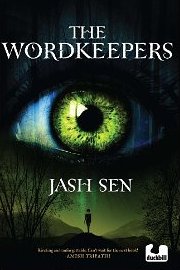
THE WORDKEEPERS by JASH SEN


Author: Jash Sen
Publication: Duckbill
ISBN: 978-93-82618-16-4
Price: INR 225

The book begins with an account of some war. This is followed by a letter from Vibhishan, the immortal king of Lanka and the brother of Ravana, of the time of Lord Rama.

A normal life of a regular busy teenager of the year 2028 is thrown topsy turvy when she receives strange messages from her mother and notices that her father's body casts no shadow in the mirror. A very strange sequence of events make her realize that she is no ordinary human, but the child of a 'wordkeeper' and is expected to live up to and act as per a prophecy. And she must rescue her mother.

Through the journey, she meets many people, who have, in their existing forms or their earlier incarnations, been characters from the great Mahabharata or the Ramayana. She discovers that she herself had been one.

Meanwhile, in the other world, in the world of the the nemesis of these wordkeepers, a handsome plan is being hatched to ensure that relevant information is collected and a trap is being laid upon the wordkeepers. This world is headed by God 'Kali'(not Goddess Kaali), the forth yug of the Hindu mithology. He has in his control, all the vices, the personifications of foul acts and all the existing demons and aims to become the sole God of the humanity.

A string of trustworthy friendships, bitter betrayals, family union, happy and sad phases, lead the teen-aged girl to discover something more about herself and take her a little further on the journey prescribed for her. And eventually, what has to happen, happens!!

An enormous eye keeps a track of all of her activities, until just before the end. 

It is interesting how the story, a very very common story of a child suddenly discovering his/her special powers (much like the characters of Harry Potter, Lexi , Henrietta and so many more in the contemporary fiction arena) is mixed with the complex story of the Hindu mythology, with a twist that incorporates all the other religions. (Kaalki, the last avatar of Lord Vishnu, is depicted through a Muslim boy here). Though the concept is brilliant and the author has done her homework really well, the final outcome falls short of the expectation that such a storyline would ideally demand. The theory of the child discovering gifted abilities has become too commonplace and childish to carry the heavy wight of the mythological tales. Though a racy narration, it becomes hard to convince oneself to read on and it gets too complex and ambiguous at places. 

A point I liked about the book is how the people, especially those of the other world, the Vishasha have been named. Dambha, Mrityu, Bhay, Vyadhi, Jara, Trishna, Shoke, Krodhe and so many more are basically the personified versions of the vices and problems we all face. For someone with a decent base of mythological knowledge, all this seems good, for others, it would have been better had a detailed glossary been give at the end.

A first of the trilogy, I think it is a fairly decent job. I hope the other two books are nice and make up for the loopholes in this one.

Monday, January 26, 2015

Sita's Sister by Kavita Kane

Title : Sita's Sister
Author : Kavita Kane
Publisher : Rupa
ISBN : 978-81-291-3484-4

So  many questions keep flooding a thinking individual's mind, more so after reading thought provoking books like Sita's Sister. What is just, what is dharma, which is bigger - a role or an individual, where does duty of one end and the personal space of another begin, who decides which role takes precedence over another, does love mean being someone's weakness or strength, should love surpass duty or the other way round, and many more.

Kavita Kane brings to fore one of those characters of the epic Ramayana who have grossly been ignored by the center stage lights. Urmila is often remembered as one of King Janak's daughters, Sita's younger sister and Lakshman's wife.  Paeans have been written about the sacrifices of the prime characters of the mythology in whose shadow many characters have been eclipsed. Lord Ram smilingly renounced his right on the throne of Ayodhya to follow the promise that his father gave to one of his wives. His worldly consort Sita gave a glimpse of her fortitude by choosing the same path for herself as was destined for her husband. Lakshman chose to let his course get automatically sealed as he could not think of not being with his elder brother during the exile period of 14 years.  Bharat decided to spend the 14 years of Ram's exile in complete abstinence of all royal pleasures as a way of his penance. These are the towering embodiments of ideals in the epic story, but often, the larger than life sagas end up neglecting the contributions of some, who silently bear the consequences of others' decisions and promises. Their greatness lies in invisibly supporting the main players.

In Sita's Sister, Kavita Kane has lent that missing voice to Urmila. The title itself is extremely well thought out, true to the life spent over-shadowed and outshone. Here Urmila is portrayed as a delicately beautiful, spirited young princess who knows her mind and has no qualms in voicing it too. She is not the one who wants to live in illusion or any make believe world. She comes across as an individual who acknowledges and accepts her situations gracefully - whether it is of being a second fiddle to the adopted elder sister Sita or submitting to the fact that her husband would remain committed to his brotherly duties over and above her. But this does not push her down rather she reciprocates the favour by being a source of strength for her loved ones.

She displays the mettle and the fortitude to provide the anchorage to her family whether it was her parental one or later her marital kinship. She tries her best to sew the relationships and while doing so, she poses some very pertinent questions from time to time. Her voiced displeasure on Bharat's decision of spending the next 14 years in Nandigram is clear example of her confident and intrepid nerve. She questions his dharma towards his wife Mandavi - 'we have talked about all sorts of dharma - of the father and the sons, of the king and the princes, of the Brahmin and the Kshatriya, even of the wife for the husband. But is there no dharma of the husband for his wife?'

There cannot be any surprise on the plot front yet the narrative from the perspective of a different character makes it appear so very uniquely distinct.

Some other characters that make their presence felt significantly in the story are that of mother Sunaina and Lakshman. Though a queen, Sunaina is a mother first and wants happiness of her daughters even if it means disregarding the political bindings. The part where she confesses her conduct in front of Urmila, would surely touch readers' inner chords. 'Probably I expected too much from you. Or, because I felt you were mine, the daughter of my flesh and blood, unlike Sita or the motherless Mandavi and Kirti. That's why I was over-protective for them but harsher to you.'

Lakshman has always given an impression of being a person who is devoutly committed to his brotherly duties all through his life and his personal relationships and bonds never surface in prominence. But in Sita's Sister, he comes across as a person who is equally vulnerable and emotional as is any other individual. He also needs someone from whom he could derive his treasure of strength. To deliver on his lofty ideals, he depends on two women in his life - his mother and his wife. Separation from his wife is no less torturous for him either but he wants his 'Mila' to make it easier for him because he acknowledges what she is, in his life 'you are my strength but also my weakness'.

This story very strongly brings back the memories of MaithiliSharan Gupt's Saket, another must read by the connoisseurs of mythology and appreciators of subtle human emotions.

Kavita Kane's language has contemporary feel to it which makes the narrative more relatable for the present-day readers. Also, some of the questions that are raised in the narrative seem equally relevant. Personally I see nothing wrong in re-defining and re-analysing the age old mythology. I firmly believe that the way any story (epic or otherwise) is understood, analysed and presented has a lot to do with a myriad of factors - the time, and the prevailing mindset, customs and culture of that time. So when we experience almost complete metamorphosis of our society with time, perhaps mythology also looks for re-definitions from time to time. 

Cannot help quoting some pearls of wisdom from the book -

...when love surpasses duty, it is salvation.

Unhappiness makes us self-absorbed, it makes one think only of oneself- of the pain, and misery one is suffering.

Only with detachment one learns the value of love versus the range of emotions - exile from attachment. 

Tuesday, December 17, 2013

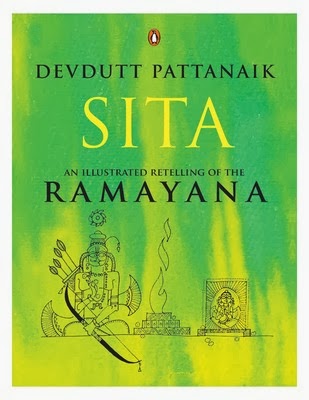
Sita by Devdutt Pattanaik

Title : Sita
Author : Devdutt Pattanaik
Publisher : Penguin India
ISBN : 978-0-143-06432-9

"You judge him but I love him Lakshman. You see your brother as an ideal and are angry because he has not lived up to your expectations. I see my husband for what he is, and understand his motivations; at every moment he strives to be what he thinks is best. I will not burden him with expectations. That is how I make him feel loved. And he sees me, knows that I will support him no matter what, even when he resorts to such devious route like an errant child."

Sita watched Lakshman's nostrils flare. She felt his embarrassment and his rage. She wanted to reach out and reassure him, but she restrained herself.
'You feel your Ram has abandoned his Sita, don't you?', she asked gently.
'But he has not. He cannot.
He is God - he abandons no one.
And I am Goddess - I cannot be abandoned by anyone.'
A mystified Lakshman returned to Ayodhya, while Sita smiled in the forest and unbound her hair.

Ramayana is an age old saga that has been passed on from generation to generation through two primary means of communication - maukhik (orally) and likhit (written). Another medium got added to the list much later - that of moving pictures, and this has been utilized multitude of times in narrating the epic tale. But perhaps Devdutt Pattanaik's Sita, is the one, which has touched me in a way no other could. Unlike Mahabharata, Ramayana is considered to be a much simpler tale with lesser diversions and sub-tales, but here in Sita, you get all that there is to read and understand about the story of Ram - the seventh incarnate of Lord Vishnu. The supporting tales mentioned here, do not hinder the flow of the narrative, rather they are brought out at the most logical junctures where they actually belong. Quite like what was done in Jaya, the author tries to bring many sub-stories, regional twists and beliefs into the fold of the main legend. The action of Ravana is compared and contrasted with some Greek and Roman mythological figures as well.  Furthermore, there is perfect dose of analysis and commentary part in the narrative which makes 'Sita' an introspective piece of writing.

In order to stay true to the title 'Sita', the author has attempted to bring a woman's perspective in the proceedings, which has been left unregistered by the earlier story tellers. It begins with Sita's early years in her maternal house. We have been generously introduced to the childhood period of Rama and his three bothers, however, there is not much that has been written about Sita as a child. The things that interested her, her pastimes, her relationship with her parents, sisters and others in the kingdom - do not find much of a mention in many writings. Here, she is portrayed as a well-read, wise, strong and confident character. It is amazing how filling colours in a pencil sketch takes the whole creation to a completely different level and that is what happens to the character of Sita. Pattanaik also highlights the relationship that Sita shared with other women characters - the queens of Ayodhya, Anusuya, Mandodari and Trijata. Their conversations make it easy for the readers to understand the personalities and thought process of various actors. 
The unmentioned and unacknowledged trivia may seem insignificant from the perspective of moving the story forward, nevertheless, they do wonders in giving a substantial identity to each character.

Though a religious epic, Ramayana is a story which leaves many wondering and questioning about the fairness and rightfulness of the decision taken by Ram in banishing his pregnant wife. In Sita, Devdutt Pattanaik has tried to address this sensitive issue by highlighting the divine connection that Sita had with Ram, and vice-versa. Sita tried to pacify the embarrassment of Lakshman thus - 'Ram is dependable, hence God. I am independent, hence Goddess. He needs to do his duty, follow rules, and safeguard reputation. I am under no such obligation. I am free to do as I please: love him when I am separated from him, love him when I am rescued by  him, love him when he clings to me, love him even when he lets me go.' This makes Sita a highly magnanimous person and one worthy of everyone's admiration and adulation.

Devdutt Pattanaik has the acumen to bring out the untapped wisdom that is lying deep in the mythological stories of yore. After having read Jaya and Sita, one wonders, how much there is to learn from such epic tales, if one could just acquire perception like that of Pattanaik.

I cannot put a final full stop to this review before I quote a few nuggets of intellect that would make one introspect and contemplate over and over again. 

  • Kanyaa-daan - I give you Lakshmi - wealth, who will bring you pleasure and prosperity. Grant me Saraswati, wisdom. Let me learn the joy of letting go. In daan only wisdom is asked in exchange, unlike dakshina - where wealth is asked in exchange and bhiksha, where power is asked in exchange.

  • Before your wife came into your life, you were a student, with no claim on property. After your wife leaves your life, you must become a hermit, with no claim over property. Only as long as she is by your side do you have claims over wealth. Without her, you cannot perform yagna, you must  only perform tapasya.

  • From desire come all problems and all desires come from fear.

  • What we possess is temporary but what we become is permanent.

  • Most people seek to be the sun around which the world revolves. Very few are willing to be the moon, allowing others to be the sun, despite having full knowledge that they can outshine everyone else. Ram's brothers served him to upholds the integrity of the royal clan. Sita was bound by wifely obligations but only Hanuman did so out of pure love. That is why Ram held him closest.


Wednesday, November 14, 2012

Asura - Tale Of The Vanquished by Anand Neelakantan


Title : Asura - Tale of the Vanquished
Author : Anand Neelakantan
Publisher : Platinum Press
ISBN : 978-93-81576-05-2

I enjoy reading retellings of our age old epics and do not mind how different authors enthuse their creativity and imagination in the same to bring out different perspectives. I guess I must have read and reviewed close to a dozen such books which are either purely fictional or are reporting of the original story with some twists here and there.

However, 'Asura' is the first book which walks the readers through the situations and circumstances in Ravana's life and how the same made him the person he was. It was indeed interesting to read how author's flight of imagination soars in this book and brings a completely unique angle to the whole story. It would be unfair for the readers if I talk about that unimaginable twist in the review here, it is better left un-revealed.

We all are well conversant with the broad storyline of Ramayana, however the same story appears to be a completely modified version when it is narrated by different characters which are very much a part of the story or when it is being reported by a third person. In Asura, author works on the pretext of what if the opposite side - the Asura side, has its own story to tell. How many of us know about that side of the saga? Throughout the book, the narrative oscillates between Ravana and  another character Bhadra whose life was ruined by Devas. Ravana has some very strong reasons for doing what he did, including being present in the Swayamvara of Sita, followed by her abduction which led him to his own doom.

The story begins with Ravana nearing his death in the battlefield and his whole life flashes past through his eyes. A Shiva devotee, an accomplished veena player, a fine scholar - Ravana opens his heart and shares his inner feelings through the pen of Anand Neelakantan. As is the case with any human, Ravana is not immune to vulnerabilities, inabilities, fears and weaknesses either but it is interesting to read how these frailties do not eclipse the strengths of his character, some of which soar really high. I specifically liked the part where he unconditionally stood by  his wife and that is the part where the author subtly tries to draw parallelism between Rama's way of dealing with his perfection vs Ravana managing with his imperfections.

Asura is not Ramayana, it is Ravanayana. In Ravana words, "For thousands of years I have been vilified and my death is celebrated year after year in every corner of India. Why? Was it because I challenges the Gods? Was it because I freed a race from the yoke of caste-based Deva rule? You have heard the victor's tale, the Ramayana. Now hear the Ravanayana, for I am Ravana and my story is the tale of the vanquished."

Thus Asura becomes the epic tale of the subdued side and another addition to already inundated literary world of mythology in varied makeovers. However the editing needs to be tighter which would have reduced the length of the unnecessary portions in the story. There are many typos too which could have been eliminated with at least one more iteration of editing. The first half deals with a lot of guerilla wars when Ravana tries to establish his kingdom in Lanka and the details become too overwhelmingly drab at some places which readers would want to skip. Though I enjoyed reading Ravana's tale, I found something really amiss. Ravana has been  portrayed as an able ruler who stood by his people but somehow he fails to create the aura which Anand attempted to create in this book. I don't know whether to blame it on my conditioned mind or lack of magic in narration, Asura ends up being just another view point, nothing more nothing less.

Tuesday, July 10, 2012

Interview with Ravi Venu


Ravi Venu is a debutant author of 'I, Rama' (reviewed here) - the first book of a trilogy on Ramayana. Ravi has keen interest in mythological and legendary subjects, and has done a lot of research on various great heroes and hero worship across multiple civilizations.
Here through this e-interview, he shares his experience of penning down his first book and his views on various other subjects.

           1.  What made you pick mythology as the theme for your first book? 

I am a history and mythology buff and I believe Myths have a starting point in history somewhere. Also, some of the greatest minds have written the epics of Mahabarat and Ramayan foreseeing the future and keeping in line with the past.
I also believe Mythology holds key to some of our critical lost links in evolution and thereby our future and when put together, it makes a fantastic meet for a progressive mind.

Having grown up hearing these great tales, it is essential that these epics be retold for the coming generations to make them associate with their roots. I felt the urge to talk Rama, my most favourite God, who knows what it is to run a life of a human and so it began.

2. What idea inspired you to retell Ramayana? What did you feel was missing in the earlier versions of this great epic?

Rama, is the need of the hour to many of us, although we brush it aside as a simple story with not much of drama enough, to be very dry with a lot of 'gyan', the tale is pregnant with several sequences that bring about the God in him or the lift to eternity by humans. 

Rama, unlike all the other Gods can feel what it is to be a complete human - he was a caring brother, duty bound son,  loving husband and a righteous ruler. He faces very strong road blocks on his way, which are not necessary for him to clear, yet, to uphold a cause, he walks the path, the reasons and consequences are the very core of the concept that pulled me to talk Ramayana.

And, I would not necessarily say missing but they can be arranged to make people relate and read to make some notes to their own lives. For instance, we all know Rama's guru was Vishwamitra, but "why" Vishwamitra is something that the epics don't spell out. Being a Guru, the great brahma rishi disappears after teaching. What happens then? 

Why does Kaikeyi not use the boons and pursue using with her husband whom she fought so keen to save? Knowing Bharata, the righteous one, very well, how did she think Rama's exile will be welcomed by him and the throne usurped? Several questions such as who is Shoorpanaka and so on, we need to connect.

If you read Ramayana as a text, you will understand Rama the Right, but do we comprehend how and why Rama "is" Rama the Right ? That is which we need to understand in today's world.

3. The women characters in your story come across as very strong and confident characters with thinking minds of their own. What was the inspiration behind these characters ?

Well, women are that, aren't they? They are strong and are capable of much larger things than what many believe in.

I always believe that there is definitely a woman behind every man, driving him. My mother of course was an inspiration for me to start appreciating women and they continue to fascinate me.
I have been a fan of several women characters in books, be it Hermione Granger or Kundhavai of Kalki's works. 
And as Rama says in the book "women are more powerful than all the celestial weapons put together" 

4. Are you satisfied with the way - I,Rama has shaped up and the response of readers for the same ?

Yes, for now, the book is just beginning to see the light. 
I am looking at a good number of younger generation reading and enjoying it. Rama's story is of two ways, the 'how to be good' and the 'Cause & Consequence' effect.

I have tried to conceptualize and portray the latter, as per the laws of nature. If you notice the epic well, Rama never judges any one nor does he hold a grudge and mostly takes an action based on a previous action.
He is a fantastic listener and a phenomenal management guru, these are some areas I want the future readers to understand and hence connect with the immortal energy by the name 'Rama'.

5. What all research did you undertake for I, Rama and now for the two subsequent books ?

Research wise - Mostly online and books of Stephen hawking, theories and documentation about human evolution and migration patterns and similar works. I do read Valmiki's version for cross reference. 
I also follow some 14th century works which give pointers into the epic.

6. How much time did the whole process take - from the inception of the idea to the final product in hand?

The inception was some 3 years ago, I penned the first chapter of the aged Rama introspecting, but then I could only write a few lines and more research and other domestic situations came to the front. Rama however, held me through the time and ensured that His book is done.

The book came up as a product in the month of May 2012. 

7. You must have gone through various stages of the process involved in getting a book in the market after you finished writing it. Could you please share with us your experience of this process, how easy or difficult it is for a beginner in this field?

Honestly, it is very difficult being a writer, publisher and distributor. The marketing is another giant, coming from the USA, with Amazon it is not very difficult to market / publish / sell one's product but then India is still developing in that area. I hope people encourage my work and more such authors. Creativity is born in writing, I hope there are a lot of creative writers coming up, especially Indians.

By the way, I am trying to launch a web portal to help people with a platform to show case their books and sell them online via some of the leading shopping companies. 

8. What next after trilogy? Do you plan to work on Mahabharata after Ramayana?

I am working on two stories apart from my next volumes, one is on Skanda and other is a super natural - historical thriller based on the Gajini plunder of Somnath and the Cholas at that time as a Pan-India book.

9. Among the contemporary authors, who inspires you the most? Who is your all time favourite author? Which are your favourite books ?

My favorite would be JK Rowling, Sidney Sheldon and Dan Brown. Among current Indian authors, I have read and enjoyed Mr.Banker's Armies of Hanuman. 
All time favorite and guru of my mind is Kalki R Krishnamurthy. 
Favorite books are a plenty, of course the great Indian epics. 

10. Why do you think so many people are working on retelling/redefining mythology these days? Doesn't every individual redefine a story and its characters in his/her unique manner and that is how it should be?

Depends on the individual, I believe most of the stories across the globe are broken down pieces from our epics, India is a country that wrote epics when the rest of the world was still working on cave drawings. But today, India is developing and most of the west is developed. A young India needs a connect with its roots and more towards the contemporary settings.

For instance, 20 years ago, a person from the west would ridicule an Indian for some beliefs, but if you observe evolution is best explained in these Indian myths, which the west found out with Darwin. By modifying a base gene FoxP2, animals and humans can communicate, today we do not know how it is possible but our epics show that cross species communication and mutation was very much there. Reptiles were born before birds and artificial insemination etc were found in these myths. Space travel and distance between planets etc is again talked about in these epics, which is still in research.

Today, armed with these epics, Indian younger generation has a future to face with massive clues to a highly creative world, all they need to do is look at the clues provided and there will be Steve Jobs and Spielberg in every town. 

My task with I, Rama, at least, was to to help propel the thought process of youth in a progressive way, to see these epics with an eye to the world ahead, after all, imagination is the key to evolution.

Thanks Ravi!! 

Sunday, July 8, 2012

I, Rama by Ravi Venu


Title : I, Rama
Author : Ravi Venu
Publisher : Cratus Media
ISBN : 978-0615582504

'I, Rama' by Ravi Venu is retelling of the epic Ramayana in the voice of the central character - Rama, himself. So it is a first person account of how events unfolded, how history got written and how his name Rama became synonymous to that of the perfect being - the almighty. The first volume of this trilogy begins from the time when Rama is in his post-prime years and in his reflective mood begins to  narrate the story of his life to his children, brothers and friends. Rama knows that the time is fast approaching when his act on Earth is coming to an end and he would be reunited with his better half soon.
The story is well known to almost all the readers already so I am not going into the story here. I would rather focus on what is it that this book offers which is unique. Yes, there are some unique points.

Through his writing, Ravi Venu has managed to slice through the awe factor surrounding the character of Rama and has attempted to bring him closer to the readers. It’s a wonderful attempt to bridge the seemingly unfathomable gap between Nara and Narayana, in order to make the character more reachable, relatable and relevant. Rama is portrayed as a human prince experiencing the complex human emotions who does not find it inappropriate verbalizing them too  -  "Clearly, human life was not easy, peppered with bonds of love, laced with a tug of war between trust and vanity."

Some may argue that it is blasphemy meddling with the epic but for me it was reassuring to see God going through similar human emotions as we all humans do every single moment of our lives - apprehensions, self doubts, love, affection and likes of those.

So I would say it is a clever way of approaching an epic and subtly conveying the message that whether it is Nara or Narayana, every one comes on Earth to fulfill some preordained goals in the bigger divine scheme, so must work sincerely towards furnishing those duties while in that role.

There are much more details on the lives of the seers (as the title of the story aptly mentions) - the clan guru Vashista, guru Vishwamitra and guru Parasurama. The author has done serious research on the stories of these sages. There is a significant portion of book devoted to Rishi Vishwamitra's confessions about his own life and the time when he was besotted with Meneka - the celestial dancer. Again a great way to bring home the point that no one, not even the great prophets could be immune to human emotions and perhaps there is no need to be immune to the same when in human form. 
Guru Vishwamitha's teachings on essence of life and universal connect make for an interesting read.

The author has taken the liberty to redefined some of the characters in the book. I specifically liked the way character of Kaikeyi is sketched, not making her to be an evil person, rather she is portrayed as an extremely intelligent warrior queen with fine acumen for politics and warfare. And Sita is not presented as a weak follower either. She is characterized as a multifaceted person who is a brilliant cook, a visionary, a philanthropist, a well read person and well acquainted with the workings of kingdoms. Interestingly Meneka's character takes a completely unique and unimaginable turn too.

Ravi Venu intelligently weaves the contemporary scientific concepts in the narration to arouse the interest of those who look for logic in mythology. The terms like inter-galactic travel, energy conversions, astral world, portals from other galaxies for travelling to Earth and vice versa, find their mention here and there. I would say this is a clever trick to woo the readers with scientific minds to read this book too.

The narrative is fast paced and interesting. Part I ends when Rama accepts his destiny and gets ready to follow his line of duty to take on Ravana in his territory.

I firmly believe that the way any story (epic or otherwise) is understood, analyzed and presented has a lot to do with a myriad of factors - the time, and the mindset, customs and culture of that time. So when we experience metamorphosis of our society with time, perhaps redefining mythology is not wrong either and the manner in which Ravi handles the above mentioned variations in his book is almost like taking a firm step towards that initiative.
Overall, I am enjoying how various thinking minds are working towards appreciating, comprehending, redefining and presenting the grand sagas with their unique fresh perspectives.

However, I would have preferred if there were more of Rama's observations, perceptions and interpretations in the narrative than the story itself which we all are well versed with.
There are a few editing mistakes too, just a few, but sufficient to go unnoticed. 

Monday, July 2, 2012

The Forest of Stories by Ashok K. Banker


Title : The Forest of Stories
Author : Ashok K. Banker
Publisher : Westland
ISBN : 978-93-81626-37-5


I have always enjoyed reading the retellings of one of the greatest epics of the world – the Mahabharata. In keeping with this urge to experience diverse perspectives on the epic, how could I skip reading Ashok Banker’s take on this grand drama? Ashok K Banker has earned a repute of being one of the best in this particular genre with his engaging Ramayana series followed by the Krishna Coriolis Series.

‘The Forest of Stories’ by Ashok Banker is a bit like the groundwork before the actual magnum opus. The way Banker has presented the stories in fine detail makes one guess that this particular series is going to be a long one. In fact, if I have the correct information, there are 17 more books to follow ‘The Forest of Stories’!

Reading through this book, I realised that I am familiar with some of the stories that are narrated in it; however, many are completely new to me. As Banker rightly points out, all these stories interconnect at some point like small tributaries meeting and merging with other tributaries, finally draining into the main river.

This set of stories is narrated by Ugrasrava , son of Lomarsana. Ugrasrava is fondly called ‘Sauti’ because he is a ‘Suta’, the son of a Kshatriya father and a Brahmin mother. The epic begins when, after a long and strenuous journey, Sauti reaches Naimisha-van, where Kulapati  Shaunaka and his many acolytes practice their austere rituals in an ashram. It is the same place where the great historical Kurukshetra battle was actually fought and history was created. It is a pleasure for the ashramites and inhabitants of the forest to listen to the narration of Mahabharata from Sauti, as he had the privilege of listening to the recitation from the creator of the epic, Vyasa, himself. Surprisingly, Sauti’s audience expands every day and it is as though the entire Naimisha-van is listening, each tree representing a dead soul in the Kurukshetra war. They are curious about the events that led to the great war, which led to their demise.

Here Banker very beautifully explains and justifies the presence of these silent listeners by saying,  ”If there is one question that has always haunted the human mind, it is this: What is the point of living? What is our purpose here on earth? Why were we put here on this mortal planet? Is there a larger plan? All humans come back to the same question: Why are we here?
“It was a question that everyone hoped the great epic Mahabharata would answer. After all, it was called the Fifth Veda for good reason. It not only told a great tale, but illuminated the essence of the human condition through the events of that great tale. And no question was more essential to the human condition than knowing why one existed.”

‘The Forest of Stories’ presents an array of seven interesting stories that does not involve any of the main characters of the great battle.  There is the tale of Parashuram and his vow to cleanse the earth of the Kshatriyas not just once but 21 times. The story of Parikshat’s son – Janamajaya, who conducts a great yagna so that all snakes of the world including King Takshaka get engulfed in the flames of the yagna and get wiped off the face of earth, also finds a place. Then there is a story of Sage Bhrigu and his wife Puloma, which leads to the story of Dushyanta and Shakuntala. Except Parashuram’s and Shakuntala’s stories, the rest were completely new to me. And of all the tales presented in this book, the story of Parshuram definitely scores over the rest, riding high on the brilliant descriptive style of the author.

Banker has maintained the authenticity of the facts by adhering to Vyasa’s text very closely and has enhanced the overall effect by his signature flair for making scenes come alive in regal grandeur. Banker not just narrates the stories; rather, he adorns them beautifully with drama and action while keeping it simple and contemporary for the new generation. His linguistic skills are par excellence and it is a delightful experience to just fly on the beautiful words of the author to the enchanting world, unraveling the mysteries of the mythological era that he describes in the pages of this book.

If you ever get overwhelmed while reading various stories and meeting the innumerable characters entering and exiting the stage, do keep this in mind – “As you hear the stories unfold, their connections will become amply clear to your enlightened mind and you will enjoy the beauty of this great narrative of Sage Krishna Dweipayana Vyasa. For it is a masterpiece of itihas, containing all the devices of poetics and aesthetics employed in their finest grain.”

After reading this book, I now look forward to reading the rest of Ashok Banker’s ‘MBA series,’ and I am sure there are many more readers who are committed to do so too. It is also interesting to read how The Mahabharata became Banker’s MBA. So don’t miss it!

I am glad that this review appeared here : http://www.sparkthemagazine.com/?p=4058

Wednesday, January 25, 2012

Bali And The Ocean Of Milk by Nilanjan P. Choudhury

Title : Bali and the Ocean of Milk

Author : Nilanjan P. Choudhury

Publisher : Harper Collins

ISBN : 978-93-5029-125-2


A fiction (The Immortals of Meluha) blew me off completely last year by the sheer magic of its originality of the plot and it did leave a lasting impression on me. I am glad I picked 'Bali and the Ocean of Milk' up which made me relive some of that wonderful experience once again.


Indrah is gripped in the fearsome fangs of ageing and he seeks the help of the holy trinity to attain back his youthfulness and his omnipotence. His Asura counterpart Bali has his own set of issues too. Many threats are looming large on Bali - from some disgruntled powers within his own territory as well as from the all time enemies, Gods. And a very cleverly planned assassination attempt on him brings to fore the failure of his invincible protective cordon. But there is only one elixir which is the answer to all problems that Bali and Indrah face and that is the Nectar. To extract the same, Ocean of Milk has to be churned by two opposite powers - Devas and Asuras with the assistance of tortoise incarnation of Viru and under the supervision of Jai. The narrative vacillates between Indrah's empire - Amravati and Bali's dominion - Tripura.


The story has everything - treachery, vengeance, tables turning, switching sides, power lust and much more. The intelligence of such authors is evident from the way they create a fictional background yet integrate the same so seamlessly with the well known facts and beliefs such as the Big Bang in this case. The author has clothed the story of manthan in a completely new avatar with contemporary touch by - incorporating political references, astutely naming the churning process - Operation Ocean's Twelve and including the lingo of prevailing times in the narrative - facebook, mobile phone cameras, animal rights violation, low-fat milk and most interesting of all, Indrah having to use hair colour - Molten Midnight by So'Real.


First 2/3rd of the book is a treat to read through - the setting of scenes, the building of characters, the amalgamation of modern age vocabulary with mythology, the witticism, the wackiness, the humour, everything is just perfect.


The initial setting is exceptionally impressive to such an extent that the expectations of readers soar too high for the climax and conclusion but I found the latter part not living upto the expectations. Not that there is any flaw in that part of the story, its just that the remaining 1/3rd fades a little in comparison to the initial section of the book which raises the bar too high. Another grouse that I have against the author or the story is - a very fleeting description of The Destroyer of the famous holy trinity - christened as Jai here. (I think the author is one of the strong patrons of 'Sholay' movie !?) The other being Sambha - the creator (I wonder why he did not pick Gabbar as the creator) and Viru - the preserver.


There are not many occasions when we get to read good English written by an Indian author and I was mightily impressed by the selection of words, phrases and overall expression of Nilanjan. The editor has done a remarkable job too and not a single sentence seems redundant in the whole narration. A true page turner. My compliments to a new rising star in the Indian literary firmament. I surely will look forward to reading more written by NPC.