Showing posts with label Ramayana. Show all posts

Monday, January 26, 2015

Sita's Sister by Kavita Kane

Title : Sita's Sister
Author : Kavita Kane
Publisher : Rupa
ISBN : 978-81-291-3484-4

So  many questions keep flooding a thinking individual's mind, more so after reading thought provoking books like Sita's Sister. What is just, what is dharma, which is bigger - a role or an individual, where does duty of one end and the personal space of another begin, who decides which role takes precedence over another, does love mean being someone's weakness or strength, should love surpass duty or the other way round, and many more.

Kavita Kane brings to fore one of those characters of the epic Ramayana who have grossly been ignored by the center stage lights. Urmila is often remembered as one of King Janak's daughters, Sita's younger sister and Lakshman's wife.  Paeans have been written about the sacrifices of the prime characters of the mythology in whose shadow many characters have been eclipsed. Lord Ram smilingly renounced his right on the throne of Ayodhya to follow the promise that his father gave to one of his wives. His worldly consort Sita gave a glimpse of her fortitude by choosing the same path for herself as was destined for her husband. Lakshman chose to let his course get automatically sealed as he could not think of not being with his elder brother during the exile period of 14 years.  Bharat decided to spend the 14 years of Ram's exile in complete abstinence of all royal pleasures as a way of his penance. These are the towering embodiments of ideals in the epic story, but often, the larger than life sagas end up neglecting the contributions of some, who silently bear the consequences of others' decisions and promises. Their greatness lies in invisibly supporting the main players.

In Sita's Sister, Kavita Kane has lent that missing voice to Urmila. The title itself is extremely well thought out, true to the life spent over-shadowed and outshone. Here Urmila is portrayed as a delicately beautiful, spirited young princess who knows her mind and has no qualms in voicing it too. She is not the one who wants to live in illusion or any make believe world. She comes across as an individual who acknowledges and accepts her situations gracefully - whether it is of being a second fiddle to the adopted elder sister Sita or submitting to the fact that her husband would remain committed to his brotherly duties over and above her. But this does not push her down rather she reciprocates the favour by being a source of strength for her loved ones.

She displays the mettle and the fortitude to provide the anchorage to her family whether it was her parental one or later her marital kinship. She tries her best to sew the relationships and while doing so, she poses some very pertinent questions from time to time. Her voiced displeasure on Bharat's decision of spending the next 14 years in Nandigram is clear example of her confident and intrepid nerve. She questions his dharma towards his wife Mandavi - 'we have talked about all sorts of dharma - of the father and the sons, of the king and the princes, of the Brahmin and the Kshatriya, even of the wife for the husband. But is there no dharma of the husband for his wife?'

There cannot be any surprise on the plot front yet the narrative from the perspective of a different character makes it appear so very uniquely distinct.

Some other characters that make their presence felt significantly in the story are that of mother Sunaina and Lakshman. Though a queen, Sunaina is a mother first and wants happiness of her daughters even if it means disregarding the political bindings. The part where she confesses her conduct in front of Urmila, would surely touch readers' inner chords. 'Probably I expected too much from you. Or, because I felt you were mine, the daughter of my flesh and blood, unlike Sita or the motherless Mandavi and Kirti. That's why I was over-protective for them but harsher to you.'

Lakshman has always given an impression of being a person who is devoutly committed to his brotherly duties all through his life and his personal relationships and bonds never surface in prominence. But in Sita's Sister, he comes across as a person who is equally vulnerable and emotional as is any other individual. He also needs someone from whom he could derive his treasure of strength. To deliver on his lofty ideals, he depends on two women in his life - his mother and his wife. Separation from his wife is no less torturous for him either but he wants his 'Mila' to make it easier for him because he acknowledges what she is, in his life 'you are my strength but also my weakness'.

This story very strongly brings back the memories of MaithiliSharan Gupt's Saket, another must read by the connoisseurs of mythology and appreciators of subtle human emotions.

Kavita Kane's language has contemporary feel to it which makes the narrative more relatable for the present-day readers. Also, some of the questions that are raised in the narrative seem equally relevant. Personally I see nothing wrong in re-defining and re-analysing the age old mythology. I firmly believe that the way any story (epic or otherwise) is understood, analysed and presented has a lot to do with a myriad of factors - the time, and the prevailing mindset, customs and culture of that time. So when we experience almost complete metamorphosis of our society with time, perhaps mythology also looks for re-definitions from time to time. 

Cannot help quoting some pearls of wisdom from the book -

...when love surpasses duty, it is salvation.

Unhappiness makes us self-absorbed, it makes one think only of oneself- of the pain, and misery one is suffering.

Only with detachment one learns the value of love versus the range of emotions - exile from attachment. 

Tuesday, December 17, 2013

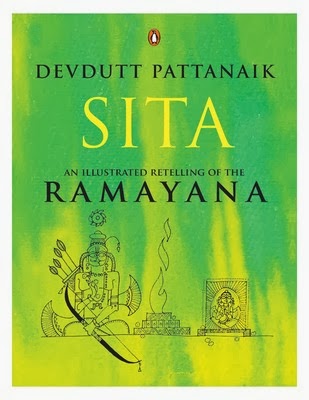
Sita by Devdutt Pattanaik

Title : Sita
Author : Devdutt Pattanaik
Publisher : Penguin India
ISBN : 978-0-143-06432-9

"You judge him but I love him Lakshman. You see your brother as an ideal and are angry because he has not lived up to your expectations. I see my husband for what he is, and understand his motivations; at every moment he strives to be what he thinks is best. I will not burden him with expectations. That is how I make him feel loved. And he sees me, knows that I will support him no matter what, even when he resorts to such devious route like an errant child."

Sita watched Lakshman's nostrils flare. She felt his embarrassment and his rage. She wanted to reach out and reassure him, but she restrained herself.
'You feel your Ram has abandoned his Sita, don't you?', she asked gently.
'But he has not. He cannot.
He is God - he abandons no one.
And I am Goddess - I cannot be abandoned by anyone.'
A mystified Lakshman returned to Ayodhya, while Sita smiled in the forest and unbound her hair.

Ramayana is an age old saga that has been passed on from generation to generation through two primary means of communication - maukhik (orally) and likhit (written). Another medium got added to the list much later - that of moving pictures, and this has been utilized multitude of times in narrating the epic tale. But perhaps Devdutt Pattanaik's Sita, is the one, which has touched me in a way no other could. Unlike Mahabharata, Ramayana is considered to be a much simpler tale with lesser diversions and sub-tales, but here in Sita, you get all that there is to read and understand about the story of Ram - the seventh incarnate of Lord Vishnu. The supporting tales mentioned here, do not hinder the flow of the narrative, rather they are brought out at the most logical junctures where they actually belong. Quite like what was done in Jaya, the author tries to bring many sub-stories, regional twists and beliefs into the fold of the main legend. The action of Ravana is compared and contrasted with some Greek and Roman mythological figures as well.  Furthermore, there is perfect dose of analysis and commentary part in the narrative which makes 'Sita' an introspective piece of writing.

In order to stay true to the title 'Sita', the author has attempted to bring a woman's perspective in the proceedings, which has been left unregistered by the earlier story tellers. It begins with Sita's early years in her maternal house. We have been generously introduced to the childhood period of Rama and his three bothers, however, there is not much that has been written about Sita as a child. The things that interested her, her pastimes, her relationship with her parents, sisters and others in the kingdom - do not find much of a mention in many writings. Here, she is portrayed as a well-read, wise, strong and confident character. It is amazing how filling colours in a pencil sketch takes the whole creation to a completely different level and that is what happens to the character of Sita. Pattanaik also highlights the relationship that Sita shared with other women characters - the queens of Ayodhya, Anusuya, Mandodari and Trijata. Their conversations make it easy for the readers to understand the personalities and thought process of various actors. 
The unmentioned and unacknowledged trivia may seem insignificant from the perspective of moving the story forward, nevertheless, they do wonders in giving a substantial identity to each character.

Though a religious epic, Ramayana is a story which leaves many wondering and questioning about the fairness and rightfulness of the decision taken by Ram in banishing his pregnant wife. In Sita, Devdutt Pattanaik has tried to address this sensitive issue by highlighting the divine connection that Sita had with Ram, and vice-versa. Sita tried to pacify the embarrassment of Lakshman thus - 'Ram is dependable, hence God. I am independent, hence Goddess. He needs to do his duty, follow rules, and safeguard reputation. I am under no such obligation. I am free to do as I please: love him when I am separated from him, love him when I am rescued by  him, love him when he clings to me, love him even when he lets me go.' This makes Sita a highly magnanimous person and one worthy of everyone's admiration and adulation.

Devdutt Pattanaik has the acumen to bring out the untapped wisdom that is lying deep in the mythological stories of yore. After having read Jaya and Sita, one wonders, how much there is to learn from such epic tales, if one could just acquire perception like that of Pattanaik.

I cannot put a final full stop to this review before I quote a few nuggets of intellect that would make one introspect and contemplate over and over again. 

  • Kanyaa-daan - I give you Lakshmi - wealth, who will bring you pleasure and prosperity. Grant me Saraswati, wisdom. Let me learn the joy of letting go. In daan only wisdom is asked in exchange, unlike dakshina - where wealth is asked in exchange and bhiksha, where power is asked in exchange.

  • Before your wife came into your life, you were a student, with no claim on property. After your wife leaves your life, you must become a hermit, with no claim over property. Only as long as she is by your side do you have claims over wealth. Without her, you cannot perform yagna, you must  only perform tapasya.

  • From desire come all problems and all desires come from fear.

  • What we possess is temporary but what we become is permanent.

  • Most people seek to be the sun around which the world revolves. Very few are willing to be the moon, allowing others to be the sun, despite having full knowledge that they can outshine everyone else. Ram's brothers served him to upholds the integrity of the royal clan. Sita was bound by wifely obligations but only Hanuman did so out of pure love. That is why Ram held him closest.


Sunday, July 8, 2012

I, Rama by Ravi Venu


Title : I, Rama
Author : Ravi Venu
Publisher : Cratus Media
ISBN : 978-0615582504

'I, Rama' by Ravi Venu is retelling of the epic Ramayana in the voice of the central character - Rama, himself. So it is a first person account of how events unfolded, how history got written and how his name Rama became synonymous to that of the perfect being - the almighty. The first volume of this trilogy begins from the time when Rama is in his post-prime years and in his reflective mood begins to  narrate the story of his life to his children, brothers and friends. Rama knows that the time is fast approaching when his act on Earth is coming to an end and he would be reunited with his better half soon.
The story is well known to almost all the readers already so I am not going into the story here. I would rather focus on what is it that this book offers which is unique. Yes, there are some unique points.

Through his writing, Ravi Venu has managed to slice through the awe factor surrounding the character of Rama and has attempted to bring him closer to the readers. It’s a wonderful attempt to bridge the seemingly unfathomable gap between Nara and Narayana, in order to make the character more reachable, relatable and relevant. Rama is portrayed as a human prince experiencing the complex human emotions who does not find it inappropriate verbalizing them too  -  "Clearly, human life was not easy, peppered with bonds of love, laced with a tug of war between trust and vanity."

Some may argue that it is blasphemy meddling with the epic but for me it was reassuring to see God going through similar human emotions as we all humans do every single moment of our lives - apprehensions, self doubts, love, affection and likes of those.

So I would say it is a clever way of approaching an epic and subtly conveying the message that whether it is Nara or Narayana, every one comes on Earth to fulfill some preordained goals in the bigger divine scheme, so must work sincerely towards furnishing those duties while in that role.

There are much more details on the lives of the seers (as the title of the story aptly mentions) - the clan guru Vashista, guru Vishwamitra and guru Parasurama. The author has done serious research on the stories of these sages. There is a significant portion of book devoted to Rishi Vishwamitra's confessions about his own life and the time when he was besotted with Meneka - the celestial dancer. Again a great way to bring home the point that no one, not even the great prophets could be immune to human emotions and perhaps there is no need to be immune to the same when in human form. 
Guru Vishwamitha's teachings on essence of life and universal connect make for an interesting read.

The author has taken the liberty to redefined some of the characters in the book. I specifically liked the way character of Kaikeyi is sketched, not making her to be an evil person, rather she is portrayed as an extremely intelligent warrior queen with fine acumen for politics and warfare. And Sita is not presented as a weak follower either. She is characterized as a multifaceted person who is a brilliant cook, a visionary, a philanthropist, a well read person and well acquainted with the workings of kingdoms. Interestingly Meneka's character takes a completely unique and unimaginable turn too.

Ravi Venu intelligently weaves the contemporary scientific concepts in the narration to arouse the interest of those who look for logic in mythology. The terms like inter-galactic travel, energy conversions, astral world, portals from other galaxies for travelling to Earth and vice versa, find their mention here and there. I would say this is a clever trick to woo the readers with scientific minds to read this book too.

The narrative is fast paced and interesting. Part I ends when Rama accepts his destiny and gets ready to follow his line of duty to take on Ravana in his territory.

I firmly believe that the way any story (epic or otherwise) is understood, analyzed and presented has a lot to do with a myriad of factors - the time, and the mindset, customs and culture of that time. So when we experience metamorphosis of our society with time, perhaps redefining mythology is not wrong either and the manner in which Ravi handles the above mentioned variations in his book is almost like taking a firm step towards that initiative.
Overall, I am enjoying how various thinking minds are working towards appreciating, comprehending, redefining and presenting the grand sagas with their unique fresh perspectives.

However, I would have preferred if there were more of Rama's observations, perceptions and interpretations in the narrative than the story itself which we all are well versed with.
There are a few editing mistakes too, just a few, but sufficient to go unnoticed.